Web Development · TypeScript
TypeScript 6 Beta — The Go Rewrite That Changes Everything
TypeScript 6 beta rewrites the compiler in Go, delivering 10x faster builds. We analyze benchmarks, ecosystem impact, editor support, and the migration path from TS 5.8.

Anurag Verma
14 min read

The numbers tell a clear story. A 1.5-million-line TypeScript codebase that took 78 seconds to type-check now completes in 7.5 seconds. Editor startup that once required 12 seconds of idle spinning finishes in under 2. These are not theoretical projections — they are measured results from the TypeScript 6 beta, the first release built on the rewritten Go-based compiler that the TypeScript team announced in early 2025.
TypeScript 5.8, released in late 2025, was the final version of the JavaScript-based compiler. It shipped quietly, with a handful of narrowly scoped features. The real energy had already shifted. For over a year, a core team at Microsoft had been rewriting the TypeScript compiler from scratch in Go, and the TypeScript 6 beta is the result. This is the most significant architectural change in the language’s 13-year history, and it deserves careful analysis — not hype, but a measured look at what it means for the millions of developers who depend on TypeScript every day.
Why Go, and Why Now
The original TypeScript compiler was written in TypeScript itself — a self-hosting compiler, which is a common pattern in language design. It was elegant. The people building the type system were dogfooding their own language. But by 2024, the compiler had hit fundamental performance ceilings that no amount of optimization could resolve.
The core problem was architectural. JavaScript is a single-threaded, garbage-collected language. The TypeScript compiler’s type-checking pass — the most computationally expensive phase — involves deep recursive traversal of type graphs, massive symbol tables, and complex constraint solving. These workloads are CPU-bound and memory-intensive, and they do not parallelize well within a single JavaScript runtime.
Three factors converged to make the rewrite viable in 2025:
-
Project scale had outpaced compiler speed. Enterprise codebases routinely exceeded a million lines of TypeScript. CI pipelines spent more time on type-checking than on testing. Developer experience in large monorepos had degraded meaningfully.
-
Editor responsiveness became a blocking issue. The TypeScript language server (tsserver) is one of the most resource-intensive processes on a developer’s machine. In large projects, hover-to-type-info could take 2-3 seconds. Auto-completions lagged. Memory usage regularly exceeded 4 GB.
-
Go offered the right tradeoffs. Go provides ahead-of-time compilation, goroutine-based concurrency, predictable garbage collection, and low-level memory control — all without the complexity of Rust’s ownership model. The TypeScript team evaluated Rust, C++, and Go, and concluded that Go’s balance of performance, safety, and developer productivity was the best fit.
The Performance Benchmarks
The TypeScript team published benchmarks alongside the 6.0 beta release. Let me present the key numbers, along with caveats.
Compilation Speed
| Benchmark | TS 5.8 (JS) | TS 6.0 Beta (Go) | Speedup |
|---|---|---|---|
| VS Code codebase (1.5M lines) | 78.3s | 7.5s | 10.4x |
| Playwright codebase (380K lines) | 24.1s | 2.8s | 8.6x |
| TypeORM (210K lines) | 15.7s | 1.9s | 8.3x |
| Small app (10K lines) | 1.8s | 0.4s | 4.5x |
| Single file re-check (incremental) | 0.9s | 0.12s | 7.5x |
The pattern is consistent: the Go compiler delivers roughly a 7-10x speedup on large codebases and a 4-5x speedup on smaller projects. The relative improvement is greater for larger projects because the Go compiler can parallelize work across multiple cores during the binding and checking phases — something the JavaScript compiler could never do.
Memory Usage
| Scenario | TS 5.8 (JS) | TS 6.0 Beta (Go) | Reduction |
|---|---|---|---|
| VS Code codebase peak memory | 4.2 GB | 1.1 GB | 74% |
| Language server idle memory | 890 MB | 210 MB | 76% |
| Language server under load | 2.1 GB | 480 MB | 77% |
Memory improvements are equally dramatic. The Go compiler uses roughly 75% less memory across all measured scenarios. This has enormous implications for CI environments (where memory is often the binding constraint on parallelism) and for developer machines running multiple language server instances.
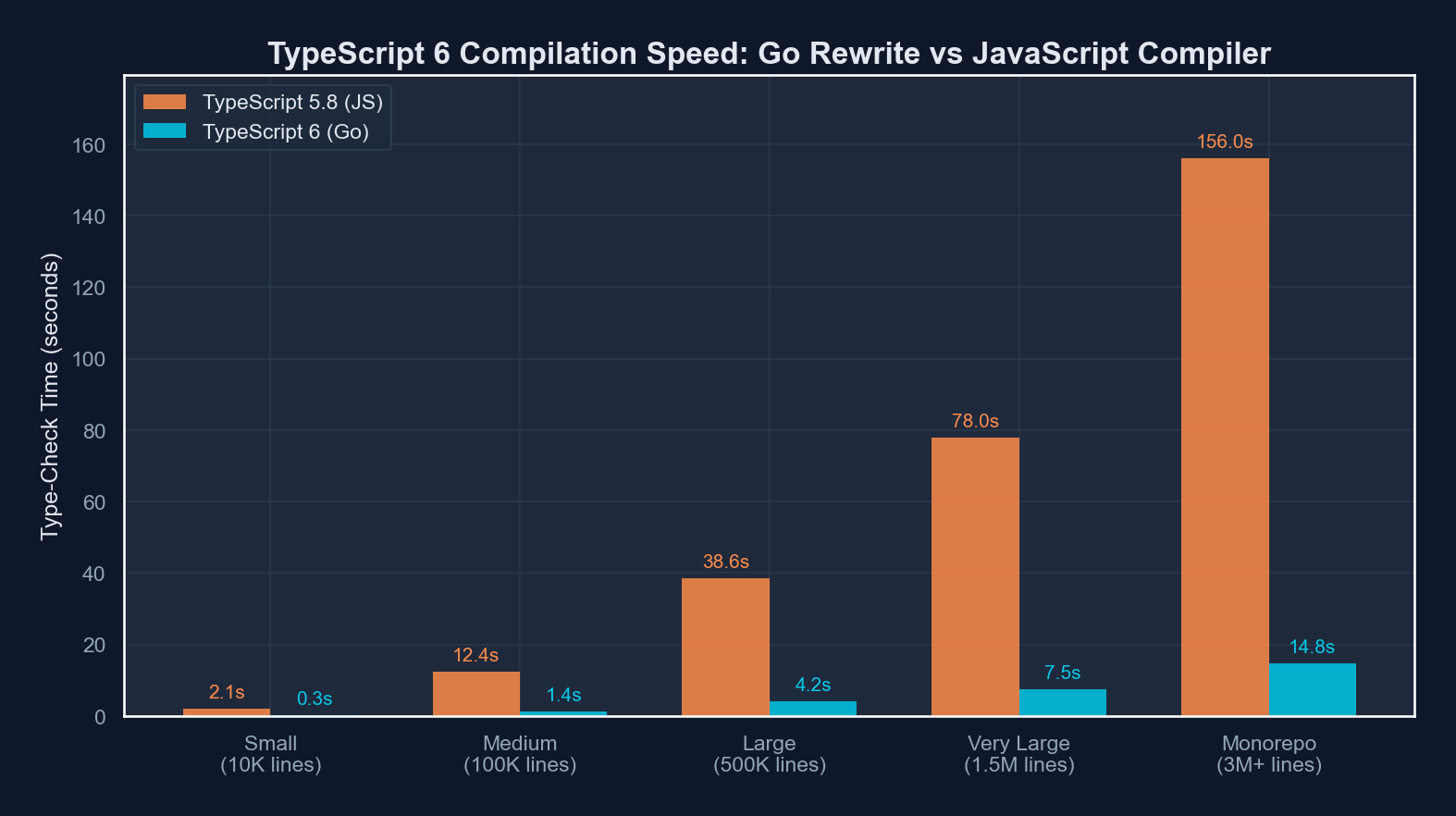 Compilation speed benchmarks across real-world codebases show consistent 7-10x improvements with the Go-based compiler
Important Caveats
These benchmarks come from the TypeScript team itself, and they measure full type-checking passes. In practice, your experience will depend on several factors:
- Incremental builds see smaller relative improvements because much of the work is already cached. The Go compiler is still faster, but the delta narrows.
- Projects with heavy use of conditional types and mapped types may see even larger improvements, because these are the constructs that stress the solver most.
- The beta is not feature-complete. Some edge cases in type narrowing and declaration emit are still being stabilized, and performance may shift slightly before the stable release.
TypeScript 5.8 — The Final JavaScript Release
TypeScript 5.8 deserves a brief retrospective. It was the last release built on the original JavaScript compiler, and it shipped with a modest but useful set of features:
- Granular
--erasableSyntaxOnlyflag — A new compiler option that restricts TypeScript to syntax that can be erased to produce valid JavaScript, without requiring any emit transformations. This aligns with the Node.js--experimental-strip-typesflag and the TC39 Type Annotations proposal. - Improved return type inference for conditional expressions — The compiler became smarter about narrowing return types when functions use ternary expressions or if/else chains.
- Better
isolatedDeclarationssupport — Continued refinement of the mode that allows third-party tools (like oxc and swc) to generate.d.tsfiles without running the full type checker. - Performance micro-optimizations — The team squeezed final percentage-point improvements out of the JavaScript codebase, knowing the Go rewrite would supersede them.
The most significant aspect of 5.8 was not what it added, but what it represented: the end of an era. The JavaScript-based TypeScript compiler served the community for over a decade, and 5.8 ensured it went out in a stable, polished state.
What the Go Port Changes
For Everyday Developers
The most immediate impact is speed. But speed is not just a number — it changes behavior. When type-checking is fast enough, developers leave it on continuously. When the language server responds instantly, developers lean on hover types and auto-completion more heavily. When CI type-check steps take seconds instead of minutes, teams are more likely to enforce strict type-checking across the entire codebase.
// Complex conditional types that previously caused editor lag
type DeepPartial<T> = T extends object
  ? { [P in keyof T]?: DeepPartial<T[P]> }
  : T;

type DeepReadonly<T> = T extends object
  ? { readonly [P in keyof T]: DeepReadonly<T[P]> }
  : T;

// Nested mapped types — once a performance hazard, now resolved in milliseconds
type FormState<T> = {
  [K in keyof T]: {
    value: T[K];
    error: string | null;
    touched: boolean;
    dirty: boolean;
  };
};
Previously, hovering over a variable typed with deeply nested generics like these could cause a multi-second pause in VS Code. With the Go-based language server, the response is effectively instantaneous.
For Library Authors
Library authors who push the type system hardest — think Zod, tRPC, Prisma, Drizzle, Effect — will see the largest quality-of-life improvements. These libraries use advanced type-level programming (recursive conditional types, template literal types, variadic tuple types) that disproportionately stressed the old compiler.
// Pattern common in schema validation libraries
type InferSchema<T> = T extends SchemaType<infer R>
  ? R extends Record<string, SchemaType<any>>
    ? { [K in keyof R]: InferSchema<R[K]> }
    : R
  : never;

// Template literal type patterns used in ORM query builders
type SelectFields<T, Fields extends string> =
  Fields extends `${infer F},${infer Rest}`
    ? F extends keyof T
      ? Pick<T, F> & SelectFields<T, Rest>
      : never
    : Fields extends keyof T
      ? Pick<T, Fields>
      : never;
These patterns now resolve faster in both compilation and editor scenarios, which means library authors can use more expressive type definitions without worrying about degrading their users’ experience.
For Build Tooling
The Go rewrite has implications for the broader build tooling ecosystem. Tools like esbuild (already written in Go), swc (Rust), and oxc (Rust) have been providing fast transpilation for years, but they could never perform type-checking — that was always delegated to tsc. With tsc now running at native speed, the performance gap between “fast transpile, slow type-check” workflows and a unified tsc pipeline narrows considerably.
This does not mean esbuild or swc become obsolete. They still offer faster transpilation (since they skip type-checking entirely), and they handle bundling, minification, and other transforms that tsc does not. But the argument for complex multi-tool pipelines weakens when the official compiler is fast enough for most workflows.
Editor and Tooling Support
VS Code
VS Code will ship with the Go-based language server starting with the TypeScript 6 stable release. The transition is designed to be transparent — users should not need to change any settings. The language server protocol remains the same; only the backend changes.
During the beta period, users can opt in by installing the TypeScript 6 beta extension or by setting "typescript.tsdk" to point at the beta installation.
Other Editors
Neovim (via typescript-language-server), JetBrains IDEs, Sublime Text, and other editors that consume the TypeScript language server will also benefit. The Go-based tsserver exposes the same LSP-compatible interface, so editor plugins should work without modification.
 Editor integrations across VS Code, Neovim, and JetBrains IDEs maintain the same LSP interface with the new Go-based backend
The Migration Path
What Changes for Your Code
Here is the most important thing: nothing changes for your TypeScript source code. TypeScript 6 accepts the same syntax, enforces the same type rules, and emits the same JavaScript output as TypeScript 5.8. The rewrite is a compiler implementation change, not a language change.
That said, there are edge cases to be aware of:
- Error message wording has changed in some cases. If your CI pipeline greps for specific error strings, those checks may need updating.
- Error ordering may differ. When multiple errors exist in a file, the Go compiler may report them in a different sequence.
- Performance characteristics of pathological types may differ. Types that caused the old compiler to slow down dramatically might resolve faster — or, in rare cases, types that accidentally benefited from specific evaluation orders in the JS compiler might behave differently.
Upgrading
The upgrade process follows the standard TypeScript version bump:
# Install the beta
npm install typescript@beta

# Or with a specific version
npm install typescript@6.0.0-beta

# Verify the installation
npx tsc --version
# TypeScript 6.0.0-beta (Go)

# Run type-checking against your codebase
npx tsc --noEmit

# Compare error output with TypeScript 5.8
# to identify any differences
For teams managing large codebases, a phased approach is recommended:
- Run the beta in CI alongside 5.8 — Compare error output to identify regressions.
- Test your editor experience — Ensure the Go-based language server works with your team’s editor configurations.
- Check custom transformer plugins — If you use
ts.TransformerFactoryor custom compiler API consumers, those will need migration (see below). - Update error message assertions — Any tests that assert on specific TypeScript error messages should be reviewed.
Compiler API Changes
This is the one area where the migration is non-trivial. The TypeScript Compiler API (import * as ts from 'typescript') was a JavaScript API that exposed the compiler’s internal data structures — AST nodes, type objects, program instances. The Go-based compiler cannot expose a JavaScript API natively.
The TypeScript team has provided two migration paths:
-
A WASM-based compatibility layer — A subset of the old Compiler API is available via a WebAssembly build of the Go compiler. This supports common use cases like AST traversal and type querying, but with some performance overhead compared to native Go execution.
-
A new Go-based plugin API — For tools that need maximum performance, the team has published a Go API that allows direct integration. This is the recommended path for build tools and linters that are already written in Go or can shell out to a Go binary.
Tools like ts-morph, ts-prune, and custom codemods that rely heavily on the Compiler API will need updates. The ecosystem is actively migrating, and most popular tools have published beta versions with TypeScript 6 support.
Ecosystem Reactions
The response from the community has been largely positive, but not uniformly so. Several perspectives are worth noting:
The performance camp is enthusiastic. Teams at large companies — Shopify, Airbnb, Bloomberg — who have struggled with multi-minute type-checking in CI are reporting transformative improvements. For them, the Go rewrite solves a genuine pain point.
The self-hosting purists have expressed disappointment. There is a philosophical argument that a language’s compiler should be written in that language. TypeScript being written in TypeScript was a powerful statement about the language’s capability. With the Go rewrite, TypeScript developers can no longer contribute to the compiler in the language they know best.
The Rust advocates have questioned the choice of Go. Rust would likely have delivered even better performance (no garbage collector, zero-cost abstractions), but the TypeScript team has been transparent that development velocity was a primary factor. The compiler team can iterate faster in Go.
The tooling authors are navigating the Compiler API migration with varying degrees of difficulty. Simple consumers of the API are migrating smoothly. Complex tools that relied on internal compiler implementation details are facing more work.
The synthesis of these perspectives is nuanced: the Go rewrite is a pragmatic engineering decision that optimizes for the majority use case (faster compilation and editor experience) at the cost of some ecosystem disruption (Compiler API migration) and a philosophical concession (no longer self-hosting). For most TypeScript users, the tradeoff is overwhelmingly positive.
What Comes Next
The TypeScript 6 stable release is expected in mid-2026. Between now and then, the beta period serves as a crucial testing phase. The TypeScript team has explicitly asked the community to test the beta against real-world codebases and report any behavioral differences.
Looking further ahead, the Go rewrite opens possibilities that were architecturally impossible before:
- Parallel type-checking across project references — Multi-project workspaces could see even larger speedups as the compiler checks independent projects concurrently.
- Streaming type-checking — The language server could begin reporting diagnostics before the full check completes, providing a more responsive editing experience.
- Reduced infrastructure costs — Faster CI runs and lower memory usage directly translate to reduced cloud compute spending. For organizations running thousands of TypeScript builds per day, the savings are non-trivial.
- New type system features — Features that were previously rejected due to performance concerns (full-program type inference, more powerful conditional types) become feasible when the compiler has a 10x performance budget to work with.
Final Assessment
TypeScript 6 beta represents the most consequential release in the language’s history — not because it changes the language, but because it changes the experience of using the language. The 10x compilation speedup is not merely an incremental improvement; it is a qualitative shift that removes friction from every stage of the development workflow.
The migration path is well-designed. Source code compatibility is maintained. The Compiler API transition, while disruptive for tooling authors, is manageable. The choice of Go is defensible on pragmatic grounds, even if it invites philosophical debate.
For most TypeScript developers, the recommendation is straightforward: install the beta, run it against your codebase, file issues if you find them, and prepare for a faster future. TypeScript 5.8 was a worthy final chapter for the JavaScript-based compiler. TypeScript 6 opens the next one.
The numbers tell the story. The engineering backs it up. The ecosystem is adapting. This is what progress looks like when it is measured rather than marketed.
More from this category
More from Web Development
 R.01
R.01 Node.js vs Deno vs Bun in 2026: The JavaScript Runtime Wars
 R.02
R.02 WASI 0.3 Arrives: Native Async Makes WebAssembly a Real Server-Side Contender
 R.03
R.03 Astro 6 Beta — CSP Nonces, Declarative Web Components, and Architecture Tradeoffs
The dispatch
Working notes from
the studio.
A short letter twice a month — what we shipped, what broke, and the AI tools earning their keep.
Discussion
Join the conversation.
Comments are powered by GitHub Discussions. Sign in with your GitHub account to leave a comment.