Web Development · Technology
WebAssembly in 2026 — WASM Has Escaped the Browser and It's Everywhere
WebAssembly is no longer just a browser technology. Server-side WASM, the component model, and WASI are reshaping how we build and deploy software across cloud, edge, and embedded systems.

Anurag Verma
6 min read
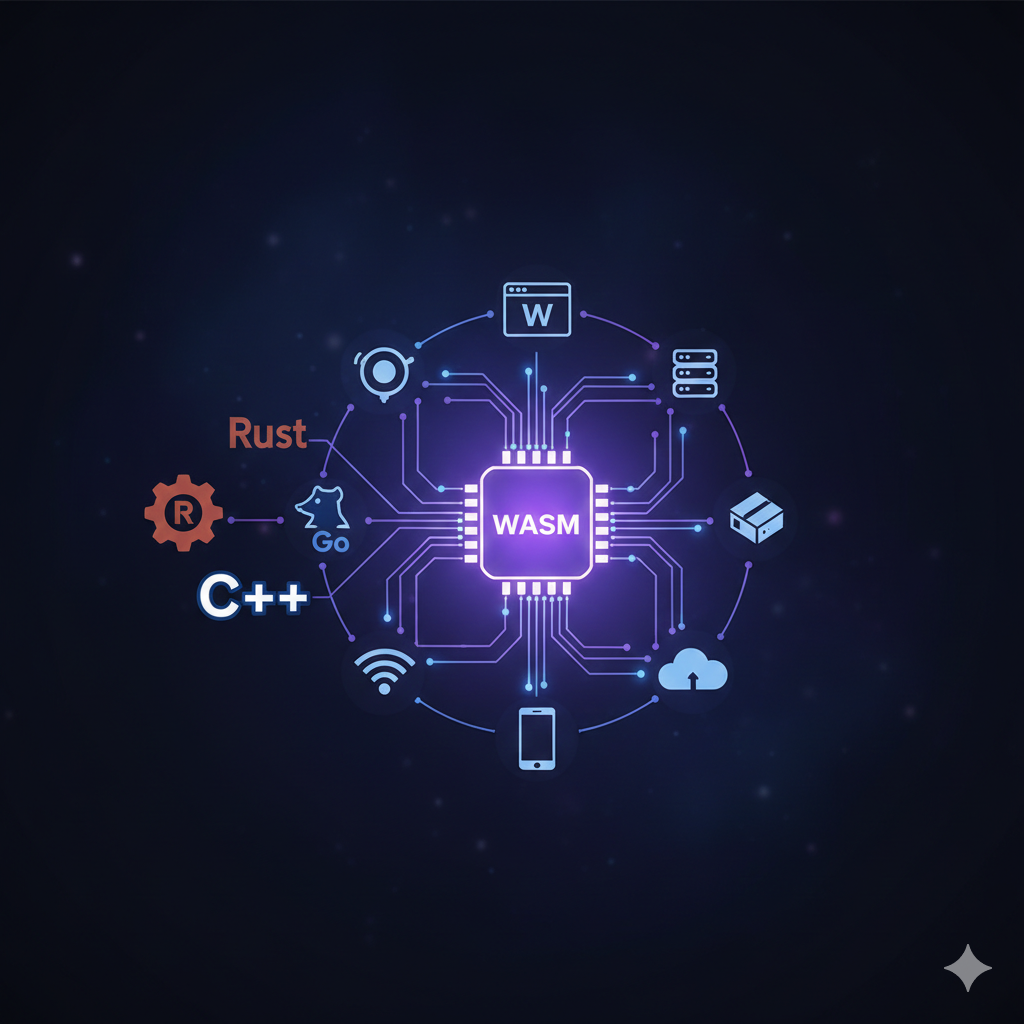
WebAssembly started as a way to run C++ games in the browser. In 2026, it is running server workloads, powering edge functions, embedding in databases, and becoming the universal runtime that Docker promised but never quite delivered.
The shift happened faster than anyone expected. WASM is no longer a browser curiosity — it is a fundamental building block of modern infrastructure.
WebAssembly has escaped the browser sandbox and is reshaping server-side computing
The State of WASM in 2026
WebAssembly adoption has reached critical mass across multiple domains:
| Domain | Adoption Level | Key Players |
|---|---|---|
| Browser | Mature | All browsers, Figma, AutoCAD, Photoshop |
| Edge Functions | Production | Cloudflare, Fastly, Vercel, Deno |
| Server-side | Growing | Fermyon, Cosmonic, wasmCloud |
| Embedded/IoT | Emerging | ByteCode Alliance members |
| Plugins/Extensions | Production | Envoy, Databases, Editors |
The technology has graduated from “interesting experiment” to “production infrastructure.”
Why WASM Won
Several factors drove WebAssembly’s expansion beyond the browser:
1. Near-Native Performance
WASM executes at near-native speed with predictable performance characteristics:
Performance Comparison (Compute-Intensive Task)
├── Native (C++): 1.0x baseline
├── WebAssembly: 1.1-1.3x (10-30% overhead)
├── Java/JVM: 1.5-2.0x
├── Python: 50-100x
└── JavaScript: 5-20x
For compute-intensive workloads, WASM delivers performance that interpreted languages cannot match.
2. Security by Default
WASM runs in a sandboxed environment with capability-based security:
- No access to filesystem unless explicitly granted
- No network access unless explicitly granted
- No system calls unless explicitly granted
- Memory isolation prevents buffer overflows from escaping
This security model is ideal for running untrusted code — plugins, user-submitted functions, multi-tenant workloads.
3. Language Agnostic
Write once, compile to WASM, run anywhere:
| Language | WASM Support | Maturity |
|---|---|---|
| Rust | Excellent | Production |
| C/C++ | Excellent | Production |
| Go | Good | Production |
| Python | Good | Production (with runtime) |
| JavaScript | Good | Production (via engines) |
| C# | Good | Production |
| Kotlin | Emerging | Beta |
| Swift | Emerging | Experimental |
Teams can use their preferred language and still target WASM.
4. Instant Cold Starts
WASM modules start in milliseconds, not seconds:
Cold Start Comparison
├── WebAssembly: 1-10ms
├── Docker container: 100-500ms
├── Lambda (Node.js): 100-300ms
├── Lambda (Java): 500-3000ms
└── Traditional VM: 10-60 seconds
This makes WASM ideal for serverless and edge computing where cold starts matter.
WASI: The System Interface
WASI (WebAssembly System Interface) standardizes how WASM modules interact with the outside world:
WASI Capability Model
├── wasi:filesystem — File and directory operations
├── wasi:sockets — Network connections
├── wasi:random — Cryptographic randomness
├── wasi:clocks — Time and timers
├── wasi:http — HTTP client/server
└── wasi:cli — Command-line interface
WASI 0.2, released in early 2025, brought the component model and made WASM truly portable across runtimes.
The Component Model
The component model is WASM’s answer to dependency management and code sharing:
// Define an interface
interface greeter {
  greet: func(name: string) -> string
}

// A component that implements greeter
component my-greeter {
  export greeter
}

// A component that uses greeter
component my-app {
  import greeter
  // ... use greeter.greet()
}
Components can be:
- Composed together at build time
- Linked dynamically at runtime
- Shared across languages (Rust component + Python component)
- Distributed as reusable packages
This is the “DLL/shared library” model that actually works across languages and platforms.
Where WASM Is Used Today
Edge Computing
Cloudflare Workers, Fastly Compute, and Vercel Edge Functions all run WASM:
// Cloudflare Worker (can call WASM)
import wasmModule from './processor.wasm'

export default {
  async fetch(request) {
    const instance = await WebAssembly.instantiate(wasmModule)
    const result = instance.exports.process(request.body)
    return new Response(result)
  }
}
Benefits at the edge:
- Sub-millisecond cold starts
- Strong isolation between tenants
- Consistent performance globally
- Smaller memory footprint than containers
Database Extensions
PostgreSQL, SQLite, and other databases now support WASM extensions:
-- Load a WASM extension
CREATE EXTENSION my_custom_function FROM 'extension.wasm';

-- Use it in queries
SELECT my_custom_function(column) FROM table;
This enables:
- Custom functions in any language
- Safe execution (sandboxed)
- Portable extensions across database instances
Plugin Systems
Applications use WASM for safe plugin execution:
| Application | Plugin System |
|---|---|
| Envoy Proxy | WASM filters for traffic processing |
| VS Code | WASM-based language servers |
| Figma | WASM plugins for design tools |
| Zed Editor | WASM extensions |
Plugins get near-native performance without risking host security.
Serverless Platforms
Fermyon Spin, Cosmonic, and wasmCloud run entire applications as WASM:
// Spin application (Rust)
use spin_sdk::http::{Request, Response};
use spin_sdk::http_component;

#[http_component]
fn hello_world(_req: Request) -> Response {
    Response::builder()
        .status(200)
        .body(Some("Hello from WASM!".into()))
        .build()
}
Deploy in milliseconds, scale to zero, pay only for execution time.
WASM vs Containers
The comparison everyone asks about:
| Dimension | WebAssembly | Docker Containers |
|---|---|---|
| Startup time | 1-10ms | 100-500ms |
| Memory footprint | KBs-MBs | MBs-GBs |
| Security isolation | Capability-based sandbox | Namespace/cgroup isolation |
| Portability | True universal binary | Linux-centric |
| Ecosystem maturity | Growing | Mature |
| Debugging tools | Improving | Excellent |
| Language support | Compiled languages | Any |
WASM is not replacing containers — it is complementing them for workloads where startup time, density, and security matter most.
Getting Started with WASM
For Rust Developers
# Install WASM target
rustup target add wasm32-wasi

# Build for WASM
cargo build --target wasm32-wasi --release

# Run with Wasmtime
wasmtime target/wasm32-wasi/release/myapp.wasm
For Go Developers
# Build for WASM (TinyGo recommended for smaller binaries)
tinygo build -target=wasi -o myapp.wasm main.go

# Run with Wasmtime
wasmtime myapp.wasm
For JavaScript/TypeScript Developers
# Use a framework like Spin
spin new -t http-js my-app
cd my-app
spin build
spin up
What’s Next for WASM
The roadmap includes:
2026:
- WASI 0.3 with async support
- Component model stabilization
- Garbage collection for managed languages
- Better debugging and profiling tools
2027 and beyond:
- WASM as container runtime substrate
- Native threading support
- GPU access for ML workloads
- Widespread adoption in embedded systems
For Web Developers
If you are building web applications, WASM is relevant in several ways:
1. Compute-intensive features. Image processing, video encoding, cryptography — move heavy computation to WASM for better performance.
2. Code sharing. Business logic written in Rust can run in the browser, on the server, and at the edge.
3. Third-party code isolation. Run untrusted plugins safely in a WASM sandbox.
4. Edge deployment. Deploy globally with sub-millisecond cold starts.
WebAssembly is not just a browser technology anymore. It is becoming a universal runtime for secure, portable, high-performance computing — and the trajectory is clear.
More from this category
More from Web Development
 R.01
R.01 Node.js vs Deno vs Bun in 2026: The JavaScript Runtime Wars
 R.02
R.02 WASI 0.3 Arrives: Native Async Makes WebAssembly a Real Server-Side Contender
 R.03
R.03 Astro 6 Beta — CSP Nonces, Declarative Web Components, and Architecture Tradeoffs
The dispatch
Working notes from
the studio.
A short letter twice a month — what we shipped, what broke, and the AI tools earning their keep.
Discussion
Join the conversation.
Comments are powered by GitHub Discussions. Sign in with your GitHub account to leave a comment.