Web Development · Industry News
Vercel's $300M Series F at $9.3B Valuation: The V0 Bet and the Future of AI-Powered Development
Vercel raised $300M at a $9.3B valuation to scale its AI Cloud platform and V0 development agent. We analyze what the funding means, how V0 is reshaping development workflows, and the competitive landscape.

Anurag Verma
10 min read

Vercel has closed a $300 million Series F round at a $9.3 billion valuation. The round was co-led by Accel and GIC, with participation from BlackRock, StepStone, Khosla Ventures, Schroders, Adams Street Partners, General Catalyst, and existing backers GV, Salesforce Ventures, and Tiger Global.
These are staggering numbers for a company that started as a hosting platform for Next.js applications. But the funding is not really about hosting anymore. It is about V0 — Vercel’s AI development agent that has reached 3.5 million unique users — and the company’s broader vision of an “AI Cloud” that fundamentally changes how software is built. Let us unpack what this means.
The Numbers in Context
| Metric | Value |
|---|---|
| Funding round | $300M Series F |
| Valuation | $9.3B |
| Additional tender offer | $300M (for employee liquidity) |
| Revenue growth | 82% year-over-year |
| V0 unique users | 3.5 million |
| User growth | 2x year-over-year |
| Lead investors | Accel, GIC |
The 82% year-over-year revenue growth is particularly notable. In a market where many developer tools companies have seen growth decelerate, Vercel is accelerating — driven in large part by V0’s rapid adoption and the broader AI development trend.
The $300M tender offer alongside the primary raise is also significant. It allows early employees and investors to take money off the table, reducing pressure to pursue a premature IPO. This is a company that is positioning for long-term value creation, not a quick exit.
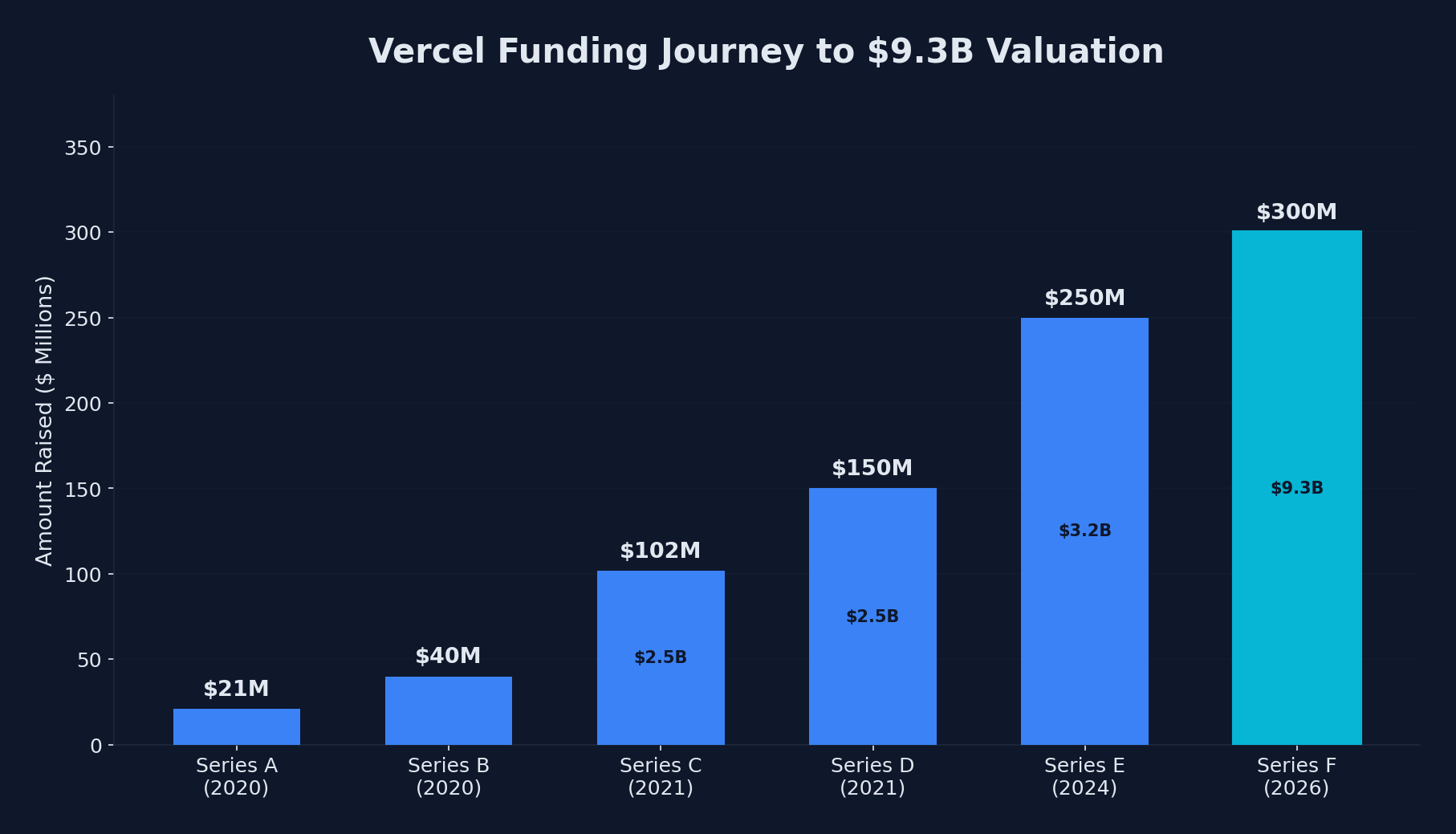 Vercel’s funding journey: from $21M Series A to $300M Series F at $9.3B valuation
V0: From UI Generator to Full-Stack Agent
When Vercel first launched V0 in 2023, it was essentially an AI-powered UI component generator. You described a component in natural language, and V0 generated React code using shadcn/ui and Tailwind CSS. It was impressive but limited.
The V0 of February 2026 is a fundamentally different product. It has evolved into a comprehensive full-stack development agent capable of:
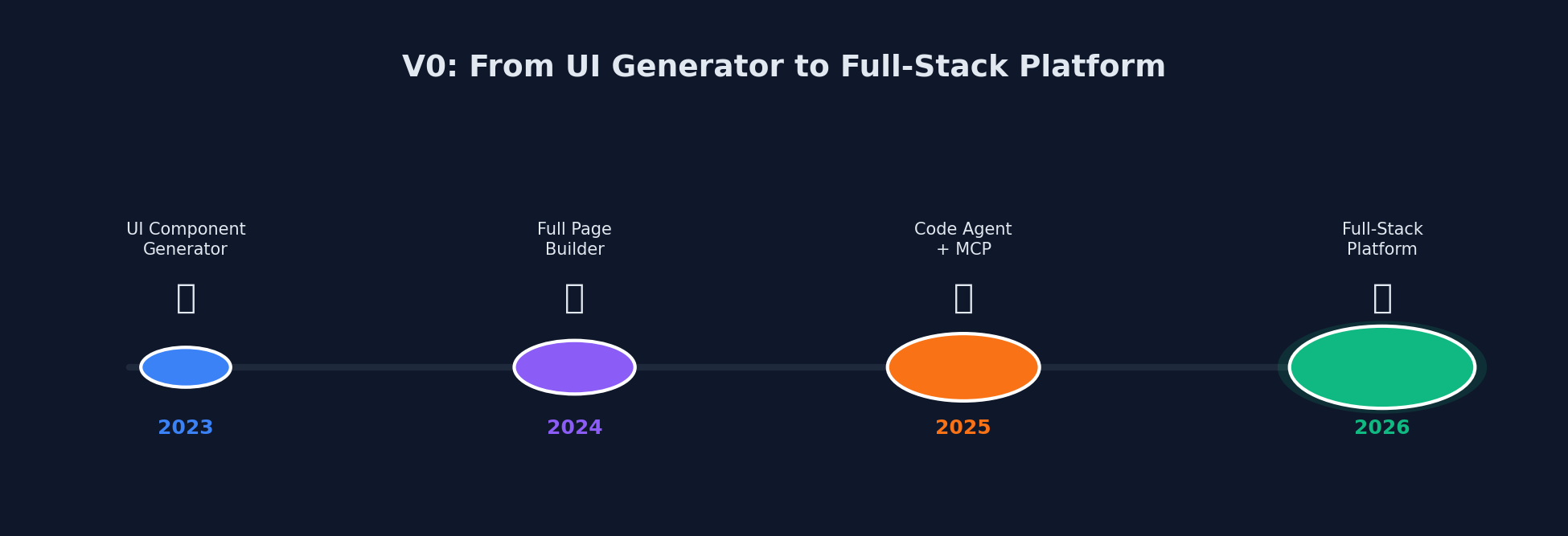 V0’s evolution from simple UI generator to full-stack development platform
Planning and Architecture
V0 can analyze a project description and generate a full architectural plan — database schema, API structure, component hierarchy, and deployment configuration.
Full-Stack Code Generation
Beyond frontend components, V0 now generates APIs, sets up databases, manages server-side logic, and creates complete Next.js applications from natural language descriptions:
User: Build a SaaS dashboard with user authentication,
      a subscription management page using Stripe,
      and a real-time analytics chart.

V0: I'll create a Next.js 15 application with:
    - NextAuth.js for authentication (GitHub + Google providers)
    - Stripe integration for subscription management
    - Recharts for real-time analytics with WebSocket updates
    - PostgreSQL with Drizzle ORM for data persistence
    - Deployed to Vercel with edge functions

    Let me start with the database schema...
Sandboxed Execution
V0 now runs in a sandbox-based runtime that can execute Node.js and Python code to verify functionality. It does not just generate code — it runs it, tests it, and iterates based on the results.
Git Integration
A new Git panel allows developers to:
- Create a new branch for each V0 chat session
- Open pull requests against the project’s main branch
- Connect to existing GitHub repositories
- Deploy automatically on merge
# V0 workflow: from idea to deployed PR
# 1. V0 generates code in a sandbox
# 2. V0 creates a branch: feature/dashboard-analytics
# 3. V0 opens a PR with generated code
# 4. Developer reviews, provides feedback
# 5. V0 iterates based on feedback
# 6. PR is merged and auto-deployed via Vercel
V0 Mobile
Vercel launched V0 Mobile in public beta, allowing developers to code through voice and camera inputs. Point your phone at a whiteboard sketch, describe what you want in plain English, and V0 generates a working application. Over 10,000 users are on the waitlist.
The “Vibe Coding” Philosophy
V0 has become synonymous with what the community calls “vibe coding” — a development approach where you describe the vibe or intent of what you want rather than writing code directly. Vercel has leaned into this branding:
Traditional development:
  1. Design mockup in Figma
  2. Manually code HTML/CSS structure
  3. Add interactivity with JavaScript
  4. Connect to backend APIs
  5. Write tests
  6. Deploy and iterate

V0 "vibe coding":
  1. Describe what you want in natural language
  2. V0 generates the full implementation
  3. Review, tweak, and provide feedback
  4. V0 iterates
  5. Merge and deploy
This is not just a workflow optimization — it represents a philosophical shift in who can build software and how. A product manager with a clear vision but limited coding skills can now produce a working prototype in minutes rather than days. A solo developer can build full-stack applications at the speed of thought.
However, it is important to be clear about V0’s current limitations:
- Complex backend logic still often requires manual refinement
- Multi-service architectures (microservices, message queues, complex data pipelines) are beyond V0’s current scope
- Production-grade security hardening still requires human expertise
- Performance optimization at scale requires developer intervention
V0 excels at going from zero to a working prototype quickly. The gap between prototype and production-ready application still requires traditional development skills.
The AI Cloud Vision
The Series F funding is explicitly earmarked for scaling what Vercel calls the “AI Cloud.” This is not just a marketing term — it represents a specific technical and business strategy:
For AI Application Builders
Vercel is positioning itself as the optimal platform for deploying AI-powered applications. Features include:
- AI SDK: Open-source toolkit for building AI interfaces in JavaScript/TypeScript
- Edge inference: Running AI models at the edge for low-latency responses
- Streaming support: First-class support for streaming AI responses in Next.js
- AI-optimized caching: Smart caching strategies for AI-generated content
// Example: AI-powered feature on Vercel's AI Cloud
import { openai } from '@ai-sdk/openai';
import { streamText } from 'ai';

export async function POST(req: Request) {
  const { messages } = await req.json();

  const result = streamText({
    model: openai('gpt-5.3-codex'),
    messages,
    // Vercel's edge runtime for low-latency responses
    // Automatic caching and rate limiting
  });

  return result.toDataStreamResponse();
}
For Traditional Web Development
The AI Cloud also enhances traditional web development workflows:
- AI-powered build optimization: Automatic code splitting, bundling decisions, and caching strategies informed by AI analysis of traffic patterns
- Smart preview deployments: AI-generated summaries of changes in each preview deployment
- Automated performance monitoring: AI-driven identification of performance regressions
The Competitive Landscape
Vercel does not operate in a vacuum. The AI-powered development platform space is crowded and competitive:
Direct Competitors
| Platform | Strengths | Weaknesses vs Vercel |
|---|---|---|
| Replit | Browser-based IDE, strong community, multiplayer | Less framework-specific, weaker enterprise features |
| Bolt (StackBlitz) | WebContainer technology, instant environments | Smaller user base, less mature AI |
| Firebase Studio (Google) | Google backing, Gemini integration, Firebase ecosystem | Later to market, less developer-focused culture |
| Cursor | IDE-native AI, strong coding experience | Not a deployment platform, different category |
| Lovable | Rapid prototyping, non-developer friendly | Limited production capabilities |
Vercel’s Moat
Vercel’s competitive advantage is the combination of three things that no competitor currently matches:
- Next.js: The most popular React framework, which Vercel creates and maintains
- Developer experience (DX): Vercel’s deployment, preview, and collaboration workflows are best-in-class
- V0 AI agent: Increasingly capable AI development integrated directly into the platform
This creates a flywheel: developers use Next.js, which drives them to Vercel for optimal deployment, which exposes them to V0, which makes them more productive, which increases their investment in the Vercel ecosystem.
The Cloudflare Factor
Cloudflare’s acquisition of Astro (covered in our separate analysis) represents a direct competitive challenge to Vercel’s strategy. Cloudflare is now assembling a similar vertical stack: framework (Astro) + platform (Workers, Pages, D1, R2) + AI (Workers AI). While Astro targets a different market segment (content-driven sites vs. full-stack applications), the strategic intent is identical: own the developer on-ramp.
What This Means for Developers
The Next.js Ecosystem Gets Stronger
With $300M in fresh capital, expect accelerated development on:
- Next.js: More features, faster releases, better performance
- Turbopack: The Rust-based bundler replacing Webpack, which should see faster stabilization
- Server Components: Deeper integration and better developer experience
- AI SDK: More models, more features, more framework integrations
V0 Will Become a Primary Workflow
For many developers, V0 will transition from a “cool demo” to a daily driver. The Git integration and sandbox execution capabilities make it viable for production work, not just prototyping. If you have not tried V0 recently, revisit it — the product has evolved dramatically.
Pricing Pressure Is Coming
Competition between Vercel, Cloudflare, Netlify, AWS Amplify, and others means hosting and platform costs will likely decrease. The AI-powered development features will be the differentiator, not basic hosting and deployment.
Be Thoughtful About Platform Dependency
Vercel’s strategy creates a powerful but opinionated developer experience. The more you invest in V0, Vercel AI SDK, and Vercel-specific features, the harder it becomes to migrate. This is not necessarily bad — the developer experience is excellent — but it is a decision you should make consciously.
// Tip: Use Vercel AI SDK with provider abstraction
// This makes it easier to switch providers later
import { generateText } from 'ai';
import { openai } from '@ai-sdk/openai';
import { anthropic } from '@ai-sdk/anthropic';

// Your code stays the same regardless of provider
const result = await generateText({
  model: process.env.AI_PROVIDER === 'openai'
    ? openai('gpt-5.3-codex')
    : anthropic('claude-opus-4-6'),
  prompt: 'Generate a user registration form with validation',
});
The Bigger Picture
Vercel’s $9.3B valuation reflects a bet that the future of software development is AI-augmented — and that the company that controls the framework, the AI agent, and the deployment platform will capture an outsized share of value.
With 82% revenue growth, 3.5 million V0 users, and a war chest of $300M, Vercel has the momentum and resources to execute on this vision. The question is whether the “one platform to rule them all” approach will win, or whether developers will prefer a more modular, best-of-breed stack.
History suggests the answer will be both. Vercel will win the segment of developers who value integrated experience and speed-to-production above all else. A meaningful segment will continue to prefer assembling their own stack from independent tools. And the competition between these approaches will drive innovation that benefits everyone.
For developers in 2026, the takeaway is clear: AI-powered development is not a future possibility — it is the current reality. Whether through V0, Cursor, Claude Code, or GitHub Copilot, the developers who learn to work effectively with AI agents will have a significant productivity advantage over those who do not. Vercel’s $300M bet is that they can be the platform where that future lives. With this funding round, they have the resources to find out.
More from this category
More from Web Development
 R.01
R.01 Node.js vs Deno vs Bun in 2026: The JavaScript Runtime Wars
 R.02
R.02 WASI 0.3 Arrives: Native Async Makes WebAssembly a Real Server-Side Contender
 R.03
R.03 Astro 6 Beta — CSP Nonces, Declarative Web Components, and Architecture Tradeoffs
The dispatch
Working notes from
the studio.
A short letter twice a month — what we shipped, what broke, and the AI tools earning their keep.
Discussion
Join the conversation.
Comments are powered by GitHub Discussions. Sign in with your GitHub account to leave a comment.