Web Development · Industry News
Cloudflare Acquires Astro: What It Means for Developers and the Web Framework Ecosystem
Cloudflare has acquired The Astro Technology Company, bringing the popular open-source web framework under its umbrella. We analyze the acquisition, its impact on Astro developers, and Cloudflare's broader web platform strategy.

Anurag Verma
9 min read

On January 16, 2026, Cloudflare announced the acquisition of The Astro Technology Company, the team behind the Astro web framework. All full-time employees of Astro are now Cloudflare employees, with founder and CEO Fred Schott joining as a senior engineering manager in Cloudflare’s Emerging Technologies and Incubation (ETI) department. The team will continue working on Astro full-time.
This acquisition represents something we have not seen much of in the web framework space: a major infrastructure company buying a framework outright. It raises important questions about the future of framework independence, the business model for open-source web tools, and what Cloudflare is really building. Let us dig in.
The Acquisition: What We Know
The Facts
- Acquirer: Cloudflare, Inc. (NYSE: NET)
- Target: The Astro Technology Company
- Announced: January 16, 2026
- Financial terms: Not publicly disclosed
- Team: All full-time Astro employees are now Cloudflare employees
- Leadership: Fred Schott becomes senior engineering manager in Cloudflare’s ETI department
- Open source status: Astro remains free, open-source, and MIT-licensed
The Promise
Both Cloudflare and Astro have made explicit commitments:
- Astro will remain free, open-source, and MIT-licensed
- Astro will continue to run with an open governance model for contributors
- The community roadmap will remain open and public
- Astro will continue to be framework-agnostic — you can host Astro sites anywhere, not just on Cloudflare
- The Astro Ecosystem Fund will continue, with industry partners including Webflow, Netlify, Wix, and Sentry
Why This Acquisition Makes Strategic Sense
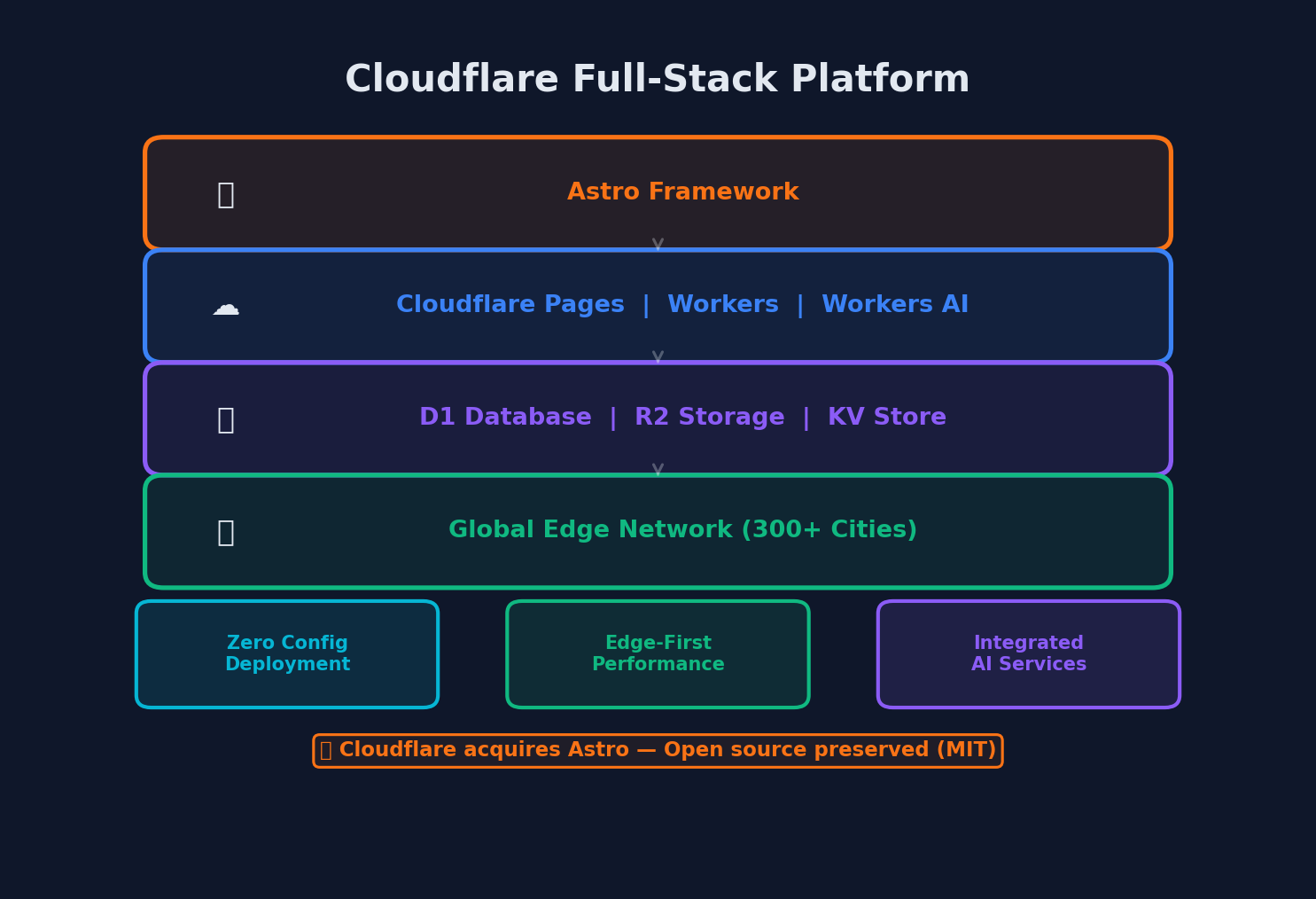 Cloudflare’s full-stack platform: from Astro framework to global edge network
For Cloudflare: Owning the Developer On-Ramp
Cloudflare has been steadily building a full-stack web development platform:
- Cloudflare Workers: Edge compute runtime
- D1: Serverless SQL database
- R2: Object storage (S3-compatible)
- KV: Key-value storage
- Queues: Message queuing
- AI: Inference at the edge
- Pages: Static site and full-stack deployment
What Cloudflare has been missing is a framework — the tool developers use to actually build the applications that run on all of these primitives. By acquiring Astro, Cloudflare gains the developer on-ramp: the place where projects begin, decisions about architecture are made, and platform lock-in (or, in Astro’s case, platform flexibility) is established.
For Astro: Sustainability and Scale
The economics of open-source framework development are brutal. Astro, like many frameworks, was venture-funded. But frameworks generate revenue through hosting, consulting, or ecosystem services — all of which face stiff competition. By joining Cloudflare, the Astro team gets:
- Long-term financial sustainability without the pressure of VC-driven growth metrics
- Engineering resources from one of the largest web infrastructure companies
- Distribution through Cloudflare’s massive developer ecosystem
- Focus: the team can concentrate on making Astro great without worrying about revenue generation
Fred Schott stated this directly: “Joining Cloudflare lets us accelerate Astro’s development faster and on a much larger scale.”
Impact on Astro Developers
What Changes
In the immediate term, very little. Astro’s development continues with the same team, the same MIT license, and the same open governance. But some changes are likely over the medium term:
Deeper Cloudflare integration: Expect first-class Cloudflare adapter improvements. Deploying Astro to Cloudflare Pages and Workers will likely become even more seamless:
// astro.config.mjs - Cloudflare adapter (already exists, expect improvements)
import { defineConfig } from 'astro/config';
import cloudflare from '@astrojs/cloudflare';

export default defineConfig({
  output: 'server',
  adapter: cloudflare({
    platformProxy: {
      enabled: true,
    },
    // Expect new features: D1 integration, R2 bindings,
    // KV access, AI inference -- all first-class
  }),
});
Edge-first features: Astro’s architecture is already well-suited for edge deployment (static-first with islands of interactivity). Expect new features that take advantage of Cloudflare’s edge network — things like automatic edge caching strategies, per-region rendering decisions, and integrated analytics.
AI-powered development: Cloudflare has been investing heavily in AI inference at the edge. Expect Astro tooling to integrate AI capabilities — potentially including AI-assisted content generation, automatic image optimization using AI, and intelligent preloading.
What Should Not Change
Framework agnosticism: Both parties have committed to Astro remaining deployable anywhere. This is in Cloudflare’s interest too — a framework that is perceived as Cloudflare-only would lose the community goodwill that makes it valuable in the first place.
Open source governance: The MIT license, open roadmap, and contributor governance model are all explicitly preserved.
Core architecture: Astro’s content-first, zero-JavaScript-by-default philosophy is its defining characteristic. Cloudflare acquired Astro because of this architecture, not despite it.
Migration Concerns
For developers currently hosting Astro on other platforms (Netlify, Vercel, AWS, etc.), there is no immediate need to migrate. Astro’s adapter system ensures platform flexibility:
# Astro adapters for various platforms remain supported
npx astro add netlify    # Still works
npx astro add vercel     # Still works
npx astro add node       # Still works
npx astro add cloudflare # Still works (and will get even better)
However, it is reasonable to expect that over time, the Cloudflare deployment path will receive the most attention and the earliest access to new features. This is the natural consequence of the team being employed by Cloudflare.
The Broader Framework Ecosystem Impact
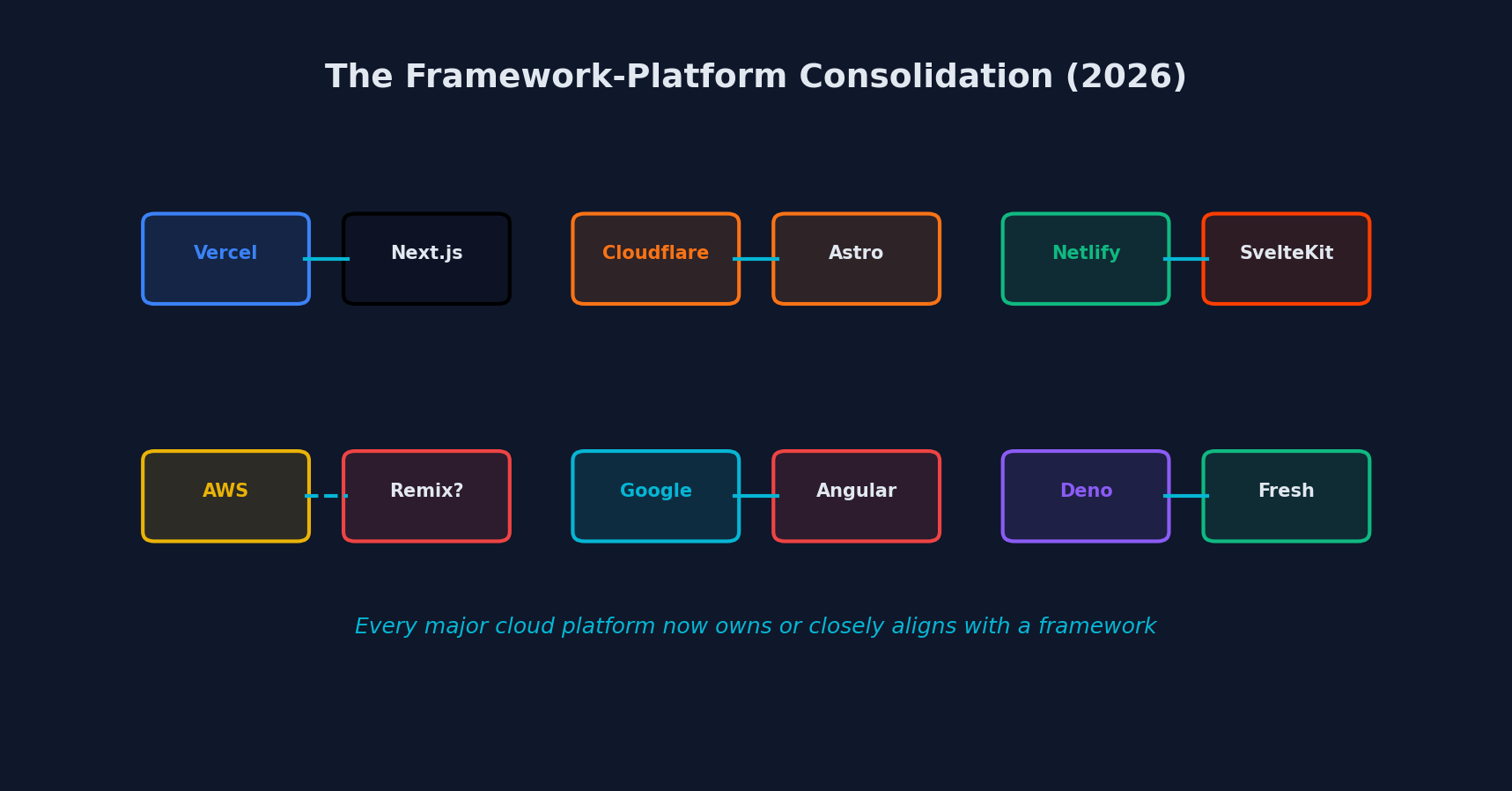 The 2026 framework-platform consolidation: every major cloud platform now aligns with a framework
The Consolidation Pattern
This acquisition fits a broader pattern of web frameworks becoming tied to hosting platforms:
| Framework | Platform Affiliation |
|---|---|
| Next.js | Vercel (creator and primary maintainer) |
| Nuxt | Ecosystem-funded, no single platform |
| Remix | Shopify (acqui-hired, now part of React Router) |
| SvelteKit | Vercel (hired Rich Harris) |
| Astro | Cloudflare (acquired) |
| Angular | Google (internal team) |
The trend is clear: major web frameworks are increasingly backed by companies with hosting or platform interests. This raises legitimate questions about neutrality and whether framework decisions will be influenced by platform business objectives.
Should Developers Be Concerned?
The honest answer is: somewhat, but probably not dramatically.
The bull case: Platform backing gives frameworks financial sustainability and engineering resources they would not otherwise have. Next.js would not be what it is without Vercel’s investment. Astro will likely ship faster and better with Cloudflare’s resources behind it.
The bear case: When a framework is owned by a platform, there is an inherent tension between “what is best for all users” and “what drives adoption of our platform.” Subtle decisions — which features get prioritized, which adapters get the most attention, which deployment targets are tested most thoroughly — can gradually tilt the playing field.
The pragmatic view: Use the best tool for your needs. Monitor the open-source governance. If Astro starts making decisions that feel platform-captured, the MIT license means the community can fork. That fork threat is, itself, a powerful incentive for Cloudflare to maintain neutrality.
What This Means for Content-Driven Websites
Astro’s core value proposition is building fast, content-driven websites. It is used by major brands including Unilever, Visa, and NBC News, as well as hundreds of thousands of developers. Cloudflare’s infrastructure strengths align well with this use case:
Performance at the Edge
---
// src/pages/blog/[slug].astro
// Static pages built at build time, served from Cloudflare's 300+ PoPs
import { getEntry } from 'astro:content';

const { slug } = Astro.params;
const post = await getEntry('blog', slug);
const { Content } = await post.render();
---

<article>
  <h1>{post.data.title}</h1>
  <Content />
</article>
A static Astro page served from Cloudflare’s CDN is already extremely fast. But deeper integration could enable:
- Automatic smart caching: Cloudflare could analyze content patterns and automatically set optimal cache strategies per page
- Edge-side personalization: Serve mostly-static pages with small dynamic elements computed at the edge, without requiring full SSR
- Integrated image optimization: Astro’s
<Image />component could leverage Cloudflare Images natively, reducing configuration overhead
AI-Enhanced Content
With Cloudflare’s Workers AI, Astro could gain built-in support for AI-powered content features:
---
// Hypothetical future Astro + Cloudflare AI integration
import { ai } from 'astro:cloudflare';

const summary = await ai.summarize(post.body, { maxLength: 200 });
const relatedTopics = await ai.extractTopics(post.body);
---

<aside>
  <h3>Summary</h3>
  <p>{summary}</p>
  <h3>Related Topics</h3>
  <ul>
    {relatedTopics.map(topic => <li>{topic}</li>)}
  </ul>
</aside>
Practical Recommendations for Developers
If You Are Already Using Astro
- Keep building. Nothing about your current workflow needs to change immediately.
- Stay on the latest version. The team will continue shipping updates at the same cadence.
- Watch the Cloudflare adapter. It will likely become the most feature-rich and performant deployment target.
- Participate in governance. The open roadmap and community governance are your insurance policy. Use them.
If You Are Evaluating Astro for a New Project
This acquisition makes Astro a stronger choice for content-driven websites, not a weaker one. The financial sustainability, engineering resources, and infrastructure alignment with Cloudflare address what was previously Astro’s biggest risk: long-term maintainer funding.
If your project is a content-heavy site (blog, documentation, marketing pages, e-commerce catalog), Astro remains one of the best options available — now with stronger long-term backing.
If You Are Concerned About Vendor Lock-In
The MIT license is your protection. Astro’s adapter system means you are not locked into Cloudflare. And the continued participation of Netlify, Webflow, Wix, and Sentry in the Astro Ecosystem Fund signals that multi-platform support is not just an Astro commitment — it is an ecosystem commitment.
Looking Ahead
The Cloudflare-Astro acquisition is a signal of where the web platform industry is heading. The infrastructure layer and the framework layer are converging. Companies that own both the tool developers use to build and the platform they deploy to have a significant competitive advantage.
For developers, this is a double-edged sword. On one hand, tighter integration means better developer experience, faster deployment, and more powerful features. On the other hand, it means the “choose your own adventure” era of mixing and matching any framework with any platform is gradually giving way to more opinionated, vertically-integrated stacks.
Astro under Cloudflare has the potential to be the best content-focused web framework with the best deployment story. Whether that potential is realized depends on Cloudflare’s commitment to the open-source promises it has made. The developer community will be watching closely.
More from this category
More from Web Development
 R.01
R.01 Node.js vs Deno vs Bun in 2026: The JavaScript Runtime Wars
 R.02
R.02 WASI 0.3 Arrives: Native Async Makes WebAssembly a Real Server-Side Contender
 R.03
R.03 Astro 6 Beta — CSP Nonces, Declarative Web Components, and Architecture Tradeoffs
The dispatch
Working notes from
the studio.
A short letter twice a month — what we shipped, what broke, and the AI tools earning their keep.
Discussion
Join the conversation.
Comments are powered by GitHub Discussions. Sign in with your GitHub account to leave a comment.