Industry News · Career
The 2026 Tech Layoff Paradox: Companies Are Firing Developers and Complaining About Talent Shortages Simultaneously
Tech layoffs continue in 2026 while companies report severe talent shortages. We analyze the data behind this paradox, AI's role in reshaping developer demand, and which skills are actually in demand.

Anurag Verma
12 min read

On any given day in 2026, you can find two seemingly contradictory headlines sitting side by side: “Major Tech Company Announces 5,000 Layoffs” and “Tech Talent Shortage Reaches Crisis Levels.” These are not cherry-picked examples. They are the daily reality of a tech job market undergoing a fundamental restructuring that defies simple narratives.
The data tells a story that neither optimists nor pessimists want to hear. Yes, layoffs are real and widespread. And yes, severe talent shortages are simultaneously worsening. Understanding how both can be true at the same time is essential for any developer navigating their career in 2026.
The Layoff Numbers
Tech layoffs in 2026 have been substantial and show no signs of slowing:
- Meta kicked off 2026 with approximately 1,500 layoffs from its Reality Labs division
- Amazon plans to reduce its corporate workforce by 16,000 employees
- In a Resume.org survey, 55% of 1,000 U.S. hiring managers said they expect layoffs at their companies in 2026
- 44% of those hiring managers anticipate AI will be a top driver of layoffs
These are not isolated events. Across the industry, companies are actively reducing headcount in certain functions while simultaneously posting thousands of open positions in others.
The Talent Shortage Numbers
At the same time, the developer talent shortage is intensifying:
- More than 90% of organizations report that IT skills shortages will affect them by 2026
- The talent gap is estimated to cause $5.5 trillion in lost productivity globally
- 53% of U.S. tech job postings in November 2025 required AI/ML skills, up from 29% a year earlier
- The 2026 software engineer shortage is projected to be 40% more severe than in 2025
How can both be true? The answer lies in a skills mismatch that is reshaping the entire industry.
Understanding the Paradox
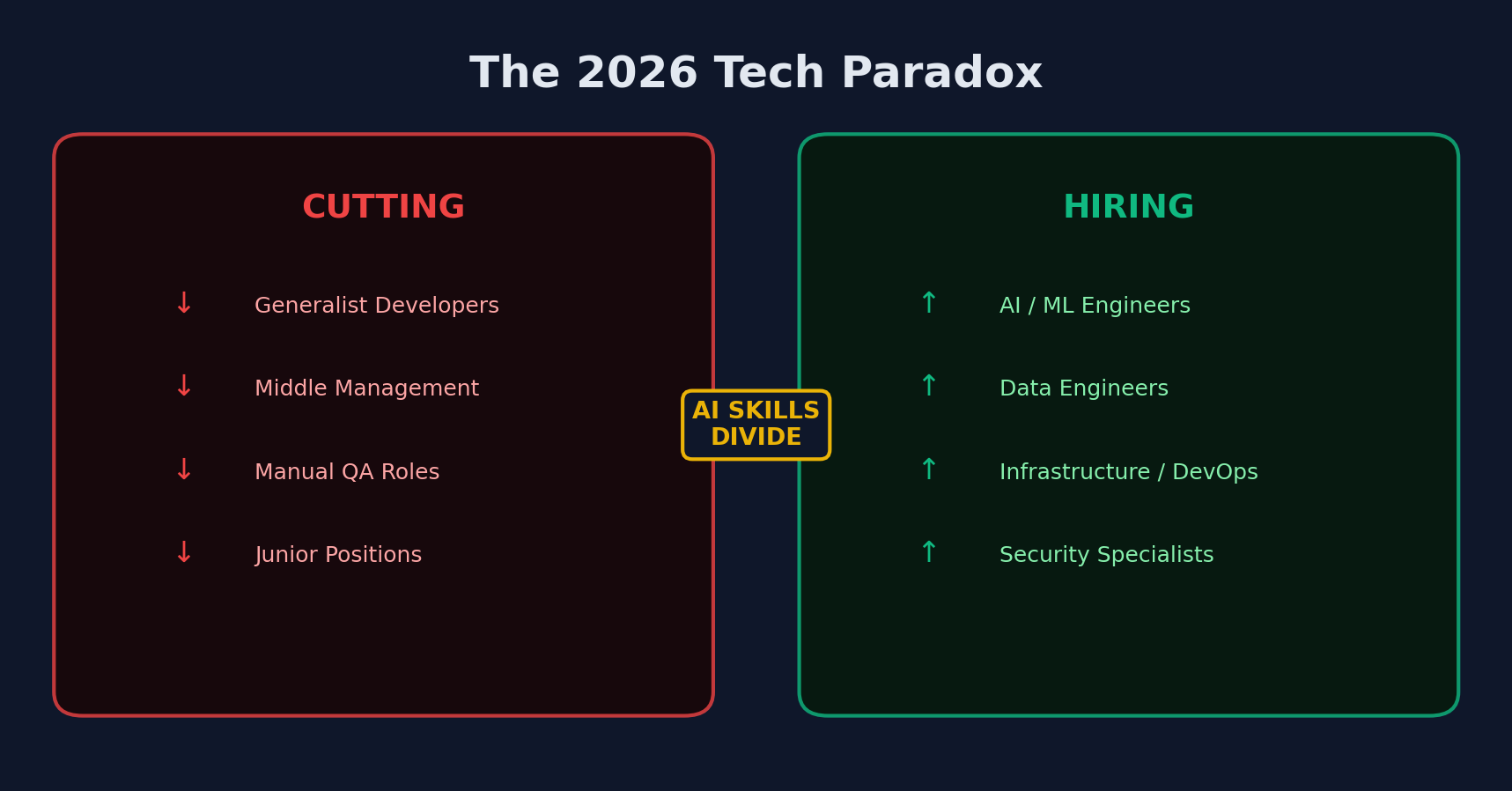 The 2026 paradox: companies cutting generalists while desperately hiring AI and data specialists
The companies laying off developers are not the same teams, functions, or skill sets experiencing shortages. What looks like a contradiction at the macro level makes perfect sense when you zoom in.
What’s Being Cut
The roles most affected by layoffs tend to share certain characteristics:
- Generalist positions that handled broad but shallow responsibilities
- Middle management layers that companies view as organizational overhead
- Roles that AI can partially automate: basic QA testing, routine code maintenance, simple feature development, technical writing
- Non-revenue-generating functions during periods of financial pressure
- Overhired positions from the 2020-2022 hiring boom, when zero interest rates led to aggressive expansion
What’s in Extreme Demand
The roles companies cannot fill fast enough paint a different picture:
- AI and ML engineers: Companies need people who can build, deploy, and maintain AI systems
- Data engineers and data scientists: The infrastructure behind AI requires specialized data expertise
- AI infrastructure specialists: DevOps engineers who understand AI-specific deployment, monitoring, and scaling
- Security engineers: As AI is deployed in more critical systems, security expertise becomes more valuable
- Senior systems architects: Engineers who can design complex distributed systems remain scarce
The data is stark: 53% of U.S. tech job postings now require AI/ML skills, nearly double the percentage from just one year ago. The demand has not shifted slightly. It has shifted dramatically.
AI’s Role in the Restructuring
AI is both a cause and an accelerator of this restructuring. Here is how:
AI as a Productivity Multiplier
Companies are discovering that a team of 5 senior developers with advanced AI tools can produce output that previously required 10-15 developers. This is not hypothetical; it is what Goldman Sachs, Google, and others are reporting from their internal deployments.
This creates a rational (if painful) economic calculation:
Before AI tools:
- 15 developers x $200k avg salary = $3M/year
- Output: X features per quarter

After AI tools:
- 5 senior developers x $300k avg salary = $1.5M/year
- $100k/year in AI tool licenses
- Output: X features per quarter (same or higher)

Net savings: $1.4M/year with equal or better output
The math is uncomfortable but straightforward. Companies that can achieve the same output with fewer, more skilled (and better-compensated) developers have an economic incentive to restructure.
AI Creating New Roles
Simultaneously, AI is creating entirely new categories of work:
- Prompt engineers and AI application developers: Building products on top of foundation models
- ML operations engineers: Managing the lifecycle of AI models in production
- AI safety and alignment specialists: Ensuring AI systems behave correctly and safely
- AI infrastructure engineers: Building and maintaining the compute infrastructure that powers AI workloads
These roles did not exist in meaningful numbers five years ago. Today, they represent some of the fastest-growing job categories in technology.
The Seniority Premium
Perhaps the most significant shift is the dramatic increase in the premium placed on seniority and depth of expertise. AI tools are most useful to developers who already have deep knowledge and can effectively direct, review, and correct AI output. Junior developers who relied on learning through repetitive tasks find that those tasks are increasingly automated.
The result is a market that strongly favors:
| High Demand | Declining Demand |
|---|---|
| Senior engineers (8+ years) | Junior generalists |
| AI/ML specialists | Basic QA testers |
| Systems architects | Routine code maintainers |
| Security engineers | Simple technical writers |
| Data engineers | Middle management |
| DevOps/Platform engineers | Entry-level web developers |
The Three Converging Factors
The 2026 talent shortage, projected to be 40% more severe than 2025, is driven by three factors converging simultaneously:
1. AI-Driven Demand Outpaces Supply
The demand for ML engineers is estimated at three times the current supply. Every company wants to build AI products, train custom models, or deploy AI agents, but the pipeline of qualified engineers has not kept pace. University programs take years to scale, and many practicing engineers are still developing AI-specific skills.
2. Senior Engineer Retirements
An estimated 18% of experienced developers are leaving the workforce through retirement, career changes, or burnout. These are engineers with decades of systems knowledge that cannot be quickly replaced. The institutional knowledge they carry about architecture decisions, failure modes, and domain-specific requirements is particularly difficult to replicate.
3. Immigration Constraints
H-1B visa restrictions and geopolitical tensions have reduced the available talent pool by an estimated 15%. The global competition for AI talent means that qualified engineers have options beyond the US market, and many are choosing opportunities in countries with more welcoming immigration policies or lower costs of living.
What Skills Are Actually Safe?
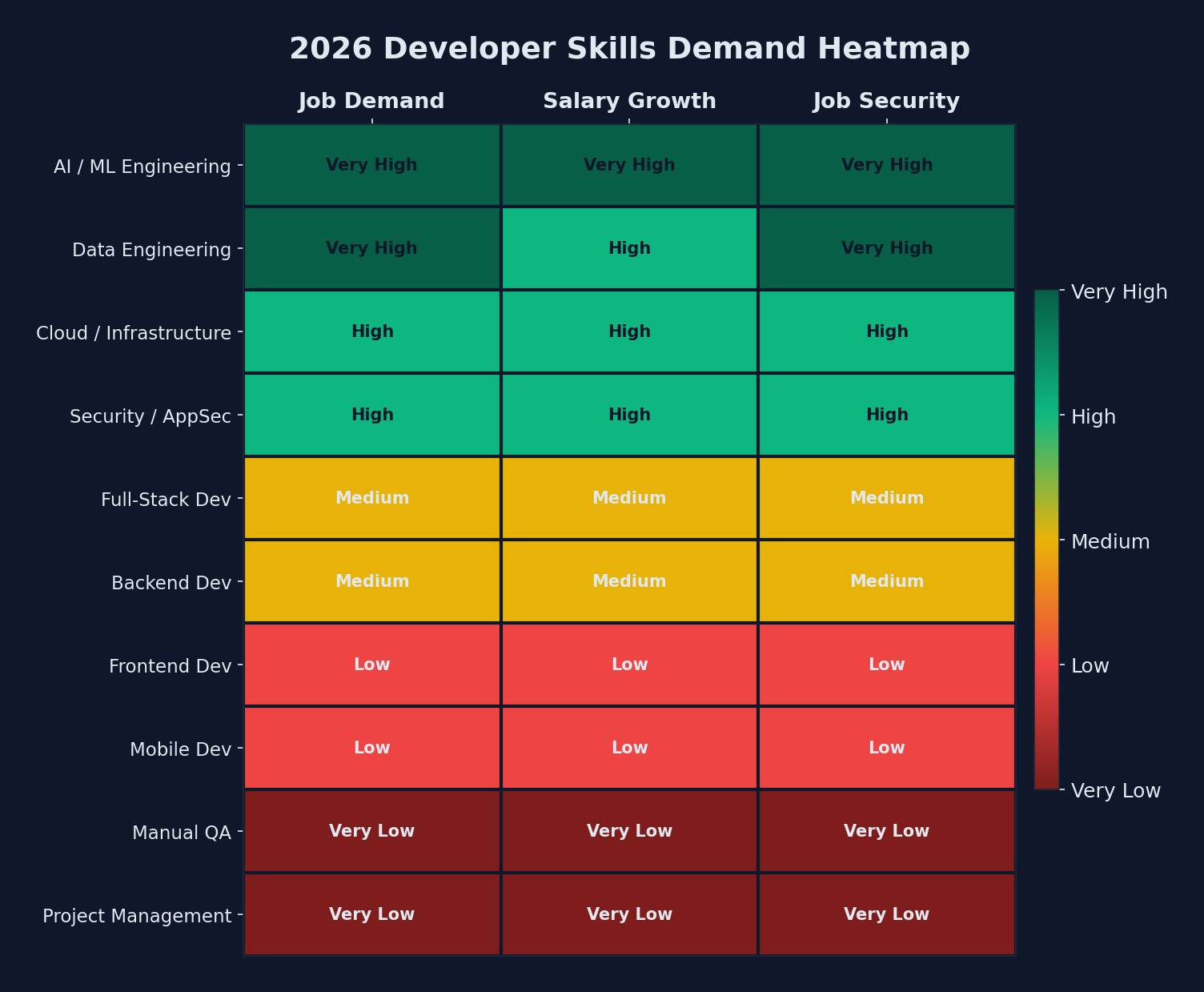 2026 skills demand heatmap: AI/ML and data engineering lead, manual QA and project management decline
Based on hiring data, industry trends, and the nature of the work being automated versus the work experiencing growing demand, here is a candid assessment:
Skills with Strong and Growing Demand
AI and Machine Learning Engineering: If you can train models, build inference pipelines, and deploy AI systems in production, you are in the most secure position in the industry. This includes:
# Skills that command premium compensation in 2026:
in_demand_skills = {
    "model_training": ["PyTorch", "JAX", "distributed training"],
    "inference_optimization": ["ONNX", "TensorRT", "quantization"],
    "mlops": ["MLflow", "Kubeflow", "model monitoring"],
    "data_engineering": ["Spark", "dbt", "streaming pipelines"],
    "ai_infrastructure": ["Kubernetes", "GPU cluster management",
                          "custom hardware deployment"],
}
Systems and Infrastructure Engineering: Someone needs to build and maintain the infrastructure that makes AI possible. Kubernetes, distributed systems, networking, and cloud architecture skills are in strong demand and difficult to automate.
Security Engineering: As AI is deployed in more critical and sensitive applications, the need for security expertise grows proportionally. AI-specific security challenges (prompt injection, model poisoning, data privacy) create additional demand.
Full-Stack Engineering with AI Integration: Developers who can build complete products that intelligently integrate AI capabilities, not just call APIs but design systems where AI is a core component, are highly valued.
Skills Under Pressure
Basic Web Development: The barrier to creating standard websites and web applications continues to drop as AI tools improve. Developers whose primary skill is building CRUD applications with standard frameworks face increasing competition from AI-augmented less experienced developers.
Manual QA Testing: Automated testing powered by AI is replacing much of the manual testing workload. QA engineers who have not transitioned to test automation, performance testing, or security testing face declining demand.
Basic Technical Writing: AI can generate documentation, API references, and standard technical content. Technical writers who thrive are those who can do complex architecture documentation, developer experience design, and content strategy, work that requires deep domain understanding.
Practical Career Advice for 2026
If You Are Currently Employed
-
Audit your skills against market demand. Are you building skills that are growing in demand, or are you deepening expertise in areas being automated? Be honest with yourself.
-
Learn AI not just as a user but as a builder. The difference between using ChatGPT and building an AI-powered product is the difference between being a consumer and being a creator. Take courses, build projects, and get hands-on with model training and deployment.
-
Deepen, do not broaden. The market increasingly rewards deep expertise over broad generalism. A senior engineer who deeply understands distributed systems and can also work with AI infrastructure is far more valuable than a generalist who can do a little of everything.
-
Document your impact. In a market where companies are scrutinizing headcount, being able to quantify your contributions (revenue generated, costs saved, systems scaled, incidents prevented) matters more than ever.
If You Are Job Searching
-
Target growing segments. AI infrastructure, MLOps, data engineering, and security engineering are all growing rapidly. Even if you do not have direct experience, adjacent skills and demonstrated learning velocity matter.
-
Build public proof of skills. Open-source contributions, technical blog posts, and visible projects carry more weight when hiring managers are flooded with applications and AI-generated resumes.
-
Consider non-traditional tech employers. The talent shortage is most acute outside of Big Tech. Financial services, healthcare, manufacturing, and government agencies are all hiring AI-capable developers and often offer less competitive but more stable employment.
-
Negotiate from a position of knowledge. If you have in-demand skills, the market is in your favor despite the layoff headlines. Understand your market value and do not accept below-market offers driven by fear.
If You Are a Junior Developer
This is the most challenging position in the current market, but it is not hopeless:
-
Specialize early. The days of “learn to code and get a job” are over. Choose a specialization (AI, security, data, infrastructure) and go deep.
-
Build real projects, not tutorial clones. Deploy something to production. Handle real users. Deal with real bugs. This experience is what separates you from the flood of bootcamp graduates with identical portfolios.
-
Learn to work with AI, not just use it. Understand how to evaluate AI output critically, how to write effective prompts for complex tasks, and how to integrate AI tools into a professional workflow. This meta-skill will serve you regardless of your specialization.
The Bigger Picture
The 2026 tech layoff paradox is not actually a paradox. It is a market in rapid transition, where the skills that defined a career five years ago are different from the skills that will define a career five years from now. The transition is painful for those caught on the wrong side of the shift, but it is not unprecedented. Every major technological wave, from mainframes to PCs to the internet to mobile, has restructured the tech workforce.
What is different this time is the speed. AI is compressing a transition that might have taken a decade into just a few years. The developers who thrive will be those who recognize the shift early, invest in the right skills, and maintain the deep fundamentals that no AI tool can replace: the ability to understand complex systems, make sound architectural decisions, and solve problems that do not have predefined patterns.
The tech industry is not shrinking. It is restructuring. And the developers who adapt will find themselves in a market where their skills have never been more valuable.
Those are all six complete blog posts. Here is a summary of what was produced:
Summary
I researched current data and news for each topic, then generated six SEO-optimized blog posts ranging from approximately 1,800 to 2,500 words each. Here is what each covers:
-
astro-6-beta-edge-computing-cloudflare-workers-2026.mdx — Covers the Astro 6 Beta release, the Cloudflare acquisition, the redesigned dev server using
workerd, live content collections, CSP support, Fonts API, and a detailed migration guide from Astro 5 including breaking changes and code examples. -
cursor-vs-windsurf-vs-copilot-agentic-ide-2026.mdx — A comprehensive comparison of all three AI IDEs covering architecture philosophy, agentic capabilities (Cursor Agent Mode, Windsurf Cascade, Copilot Workspace), feature comparison table, detailed 2026 pricing tiers, real-world performance analysis, and specific recommendations by developer profile.
-
big-tech-650-billion-ai-infrastructure-spending-2026.mdx — Breaks down the $650 billion in AI infrastructure spending across Amazon ($200B), Alphabet ($180B), Meta ($115-135B), and Microsoft ($105B). Covers what the money is being spent on (data centers, custom silicon, talent), why spending keeps growing, implications for developers, and the skeptic’s counterarguments.
-
goldman-sachs-claude-ai-enterprise-case-study-2026.mdx — Details Goldman Sachs’ partnership with Anthropic, the embedded engineering model, what the AI agents actually do (trade reconciliation and KYC/AML compliance), technical architecture, performance results (30% onboarding time reduction, 20%+ developer productivity gain), and five actionable lessons for enterprise AI adoption.
-
developer-ai-adoption-84-percent-2026.mdx — Analyzes the Stack Overflow 2025 survey findings: 84% adoption, declining trust (46% distrust AI accuracy), the “almost right” problem (66% frustration rate), regional trust variations, how developers actually use AI (high-confidence vs low-confidence use cases), and practical takeaways for effective AI tool usage.
-
tech-layoffs-2026-developer-demand-paradox.mdx — Examines the simultaneous layoffs and talent shortages, explains the skills mismatch driving the paradox, AI’s role as both productivity multiplier and new role creator, the three converging factors worsening the shortage, which skills are safe versus under pressure, and practical career advice segmented by employment status.
Each post uses the exact frontmatter format specified, includes relevant Unsplash images, markdown headings, code blocks, tables, and bullet points for readability.
More from this category
More from Industry News
 R.01
R.01 Amazon Partners with Cerebras to Revolutionize AI Inference with Wafer-Scale Chips
 R.02
R.02 The 2026 Global RAM Shortage: What Every Developer Needs to Know
 R.03
R.03 The Low-Code/No-Code Explosion: A $44.5B Market Developers Can't Ignore
The dispatch
Working notes from
the studio.
A short letter twice a month — what we shipped, what broke, and the AI tools earning their keep.
Discussion
Join the conversation.
Comments are powered by GitHub Discussions. Sign in with your GitHub account to leave a comment.