Career · Work Styles
Freelancing vs Agency vs Full-Time — Choosing Your Developer Career Path in 2026
The developer employment landscape offers more options than ever. Here's an honest comparison of freelancing, agency work, and full-time employment to help you decide.

Anurag Verma
8 min read
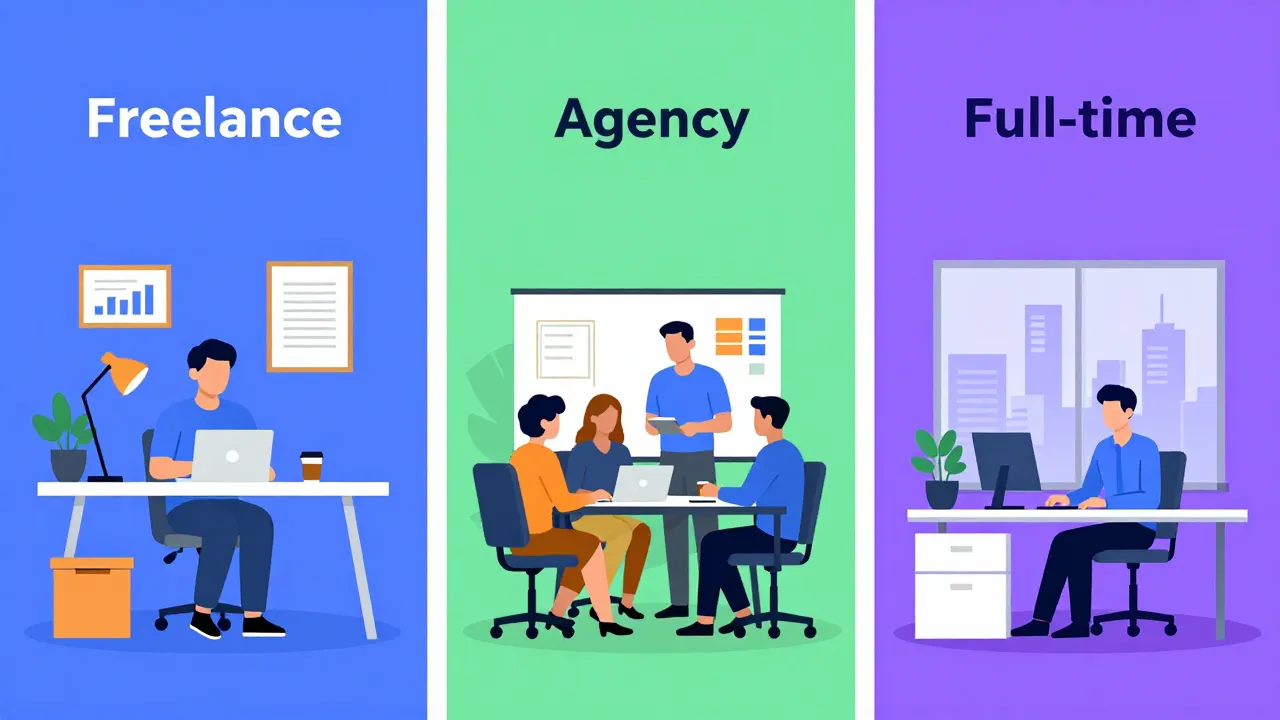
Developers have more employment options than ever. Traditional full-time roles compete with agency positions, freelance work, and hybrid arrangements. Each path offers different trade-offs in compensation, flexibility, growth, and security.
Understanding these trade-offs helps you make an intentional choice rather than defaulting to whatever comes first.
Different work arrangements suit different life stages and priorities
The Options at a Glance
| Factor | Full-Time | Agency | Freelance |
|---|---|---|---|
| Income stability | High | Medium-High | Variable |
| Income ceiling | Capped | Medium | High (uncapped) |
| Flexibility | Low | Medium | High |
| Benefits | Full | Usually | Self-funded |
| Learning opportunities | Deep (one domain) | Broad (many domains) | Self-directed |
| Job security | Medium | Medium | Low |
| Administrative burden | Low | Low | High |
Full-Time Employment
The traditional path: join a company, work on their product, receive salary and benefits.
Advantages
Financial Stability
- Predictable paycheck
- Benefits (health, retirement, PTO)
- Equity/RSUs at many companies
- Bonus structures
Career Development
- Clear progression path (usually)
- Mentorship from senior colleagues
- Deep domain expertise
- Internal mobility opportunities
Work Structure
- Defined expectations
- Team support
- Clear boundaries (in good companies)
- Less administrative burden
Disadvantages
Limited Flexibility
- Fixed schedule (though remote helps)
- Limited project choice
- Dependent on company decisions
- May be stuck on boring work
Income Ceiling
- Raises are incremental
- Major jumps require job changes
- Equity depends on company performance
Risk Concentration
- Layoffs affect everything at once
- Company failure means job loss
- Limited control over direction
Compensation Range (2026, US)
| Level | Base Salary | Total Comp (with equity) |
|---|---|---|
| Junior | $70-100K | $80-120K |
| Mid | $100-150K | $120-200K |
| Senior | $150-200K | $200-350K |
| Staff+ | $200-280K | $350-700K+ |
Note: Ranges vary significantly by location and company tier.
Best For
- Early career (learning, mentorship)
- People wanting stability
- Those who dislike business/admin work
- People building toward Staff-plus or management
- Anyone wanting clear work/life boundaries
Agency Work
Work at a company that builds software for multiple clients.
Agency Types
| Type | Projects | Client Relationship |
|---|---|---|
| Consultancy | Strategy + implementation | Long-term advisory |
| Development shop | Custom software | Project-based |
| Design agency | UI/UX + development | Campaign/project |
| Staffing/Augmentation | Embedded with client | Staff extension |
Advantages
Variety
- Multiple industries and domains
- Different tech stacks
- Constant new challenges
- Broad skill development
Exposure
- See how different companies work
- Network across many organizations
- Understand different business models
Team Environment
- Work with colleagues
- Shared learning
- Less isolation than freelance
Disadvantages
Client Dynamics
- May have difficult clients
- Less control over project direction
- Deadlines driven by client needs
Utilization Pressure
- Billable hours expectations
- Pressure during slow periods
- May be rushed between projects
Limited Depth
- Move on before seeing long-term results
- Less ownership of outcomes
- May not see projects through maintenance
Compensation
- Often lower than product companies
- Less equity upside
- Profit margins limit salaries
Compensation Range (2026, US)
| Level | Salary Range |
|---|---|
| Junior | $60-85K |
| Mid | $85-130K |
| Senior | $130-180K |
| Lead/Principal | $160-220K |
Best For
- People wanting variety over depth
- Those building broad portfolios
- Developers who enjoy client relationships
- People considering starting their own agency
- Those who get bored on long projects
Freelancing
Work independently, directly with clients, on your own terms.
Freelance Models
| Model | Description | Typical Rate |
|---|---|---|
| Hourly | Bill by hour | $50-250/hr |
| Project-based | Fixed price for scope | Varies |
| Retainer | Ongoing hours at fixed rate | $3-20K/month |
| Productized | Standard offering, fixed price | $1-10K per unit |
Advantages
Flexibility
- Choose your hours
- Choose your clients
- Choose your projects
- Work from anywhere
Income Potential
- No salary cap
- Raise rates over time
- Multiple income streams
- Keep 100% of what you bill
Independence
- No office politics
- No performance reviews
- Direct relationship with clients
- Full control over work
Disadvantages
Income Instability
- Feast or famine cycles
- Clients cancel unexpectedly
- Must constantly find new work
- No paid time off
Administrative Burden
- Finding clients (sales/marketing)
- Contracts and invoicing
- Taxes and accounting
- Benefits (health insurance, retirement)
Isolation
- No team by default
- Limited mentorship
- Must self-direct learning
- Can be lonely
Unpaid Work
- Proposals and pitches
- Contract negotiation
- Client management
- Business development
Compensation Reality
Hourly rates sound high, but:
Freelance Math Example:
Gross rate: $150/hour
× Billable hours: 1,400/year (70% utilization)
= Gross income: $210,000

Minus:
- Self-employment tax: ~$16,000
- Health insurance: ~$12,000
- Retirement contribution: ~$20,000
- Business expenses: ~$5,000
- Unbillable time value: significant

Effective comparison to salary: ~$130-150K equivalent
Rule of thumb: Your hourly rate should be 2-3x what you’d earn hourly as an employee to match total compensation.
Typical Rates (2026, US)
| Experience | Hourly Rate |
|---|---|
| Junior | $50-80 |
| Mid | $80-120 |
| Senior | $120-180 |
| Specialist/Expert | $180-300+ |
Best For
- Experienced developers (5+ years typically)
- People wanting maximum flexibility
- Those with strong networks
- Developers with specialized skills
- Parents or caregivers needing flexible schedules
- People building toward their own products
Hybrid Approaches
Many developers combine approaches:
Part-Time Employment + Freelance
- Stable base income from part-time role
- Freelance for extra income and variety
- Balance of stability and flexibility
Contract-to-Hire
- Start as contractor
- Convert to full-time if mutual fit
- Try before committing
Fractional Roles
- Part-time senior role at multiple companies
- Common for CTOs, architects
- High rates, multiple income streams
Employee + Side Projects
- Full-time job for stability
- Side projects for extra income or learning
- Path to potential entrepreneurship
Making the Decision
Consider Your Life Stage
| Situation | Recommendation |
|---|---|
| Early career | Full-time (learn from others) |
| Building family | Full-time (stability, benefits) |
| Established, want variety | Agency or freelance |
| Want location independence | Freelance or remote full-time |
| Building toward entrepreneurship | Freelance (learn business skills) |
| Approaching retirement | Freelance (control workload) |
Consider Your Risk Tolerance
| Risk Tolerance | Recommendation |
|---|---|
| Risk-averse | Full-time employment |
| Moderate | Agency or hybrid |
| Risk-tolerant | Freelance |
Consider Your Skills Beyond Coding
Freelancing requires:
- Sales and marketing
- Contract negotiation
- Client management
- Financial planning
- Self-motivation
If these sound terrible, full-time is likely better. If they sound exciting, freelancing might fit.
Transitioning Between Paths
Full-Time → Freelance
- Build savings (6-12 months expenses)
- Start side projects while employed
- Build portfolio and testimonials
- Establish initial clients before leaving
- Give proper notice, leave on good terms
Freelance → Full-Time
- Decide what you want (stability, team, benefits)
- Update resume with freelance highlights
- Be ready to explain the transition
- Consider contracting as a bridge
Full-Time → Agency
Generally straightforward:
- Similar interview process
- Highlight adaptability and learning speed
- Show interest in variety
Agency → Full-Time
Position agency experience as:
- Broad exposure to technologies
- Ability to learn quickly
- Experience with different team dynamics
The Honest Assessment
No path is universally better. Each has trade-offs:
- Full-time offers stability at the cost of flexibility
- Agency offers variety at the cost of depth
- Freelance offers freedom at the cost of security
The right choice depends on your:
- Financial situation
- Risk tolerance
- Career goals
- Life circumstances
- Personality and preferences
And it can change. Many successful developers move between paths throughout their careers. The goal is not to pick the “right” answer forever, but to make the right choice for right now.
More from this category
More from Career
 R.01
R.01 From Freelancer to Agency Owner — The Uncomfortable Truths After Year One
R.02 GSoC 2026: The Complete Guide That Actually Gets You Selected (185 Organizations, Stipends, Timeline, and Strategy)
 R.03
R.03 Developer Career Paths in 2026 — IC, Management, and Everything In Between
The dispatch
Working notes from
the studio.
A short letter twice a month — what we shipped, what broke, and the AI tools earning their keep.
Discussion
Join the conversation.
Comments are powered by GitHub Discussions. Sign in with your GitHub account to leave a comment.