Business · Strategy
Build vs Buy — A Framework for Engineering Decisions in 2026
Every engineering team faces build vs buy decisions constantly. Here's a practical framework for making these decisions without analysis paralysis.

Anurag Verma
7 min read
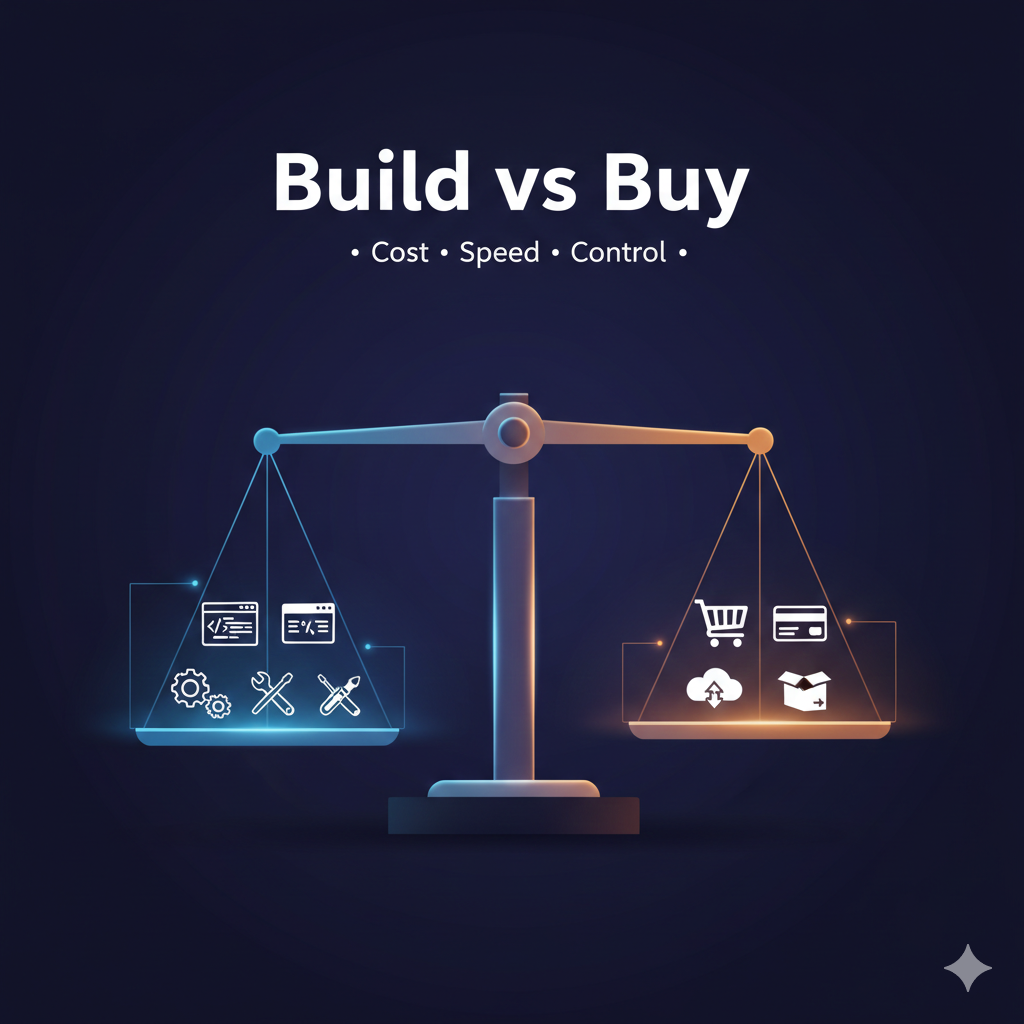
Build vs buy is one of the most frequent decisions engineering teams face. Build your own authentication? Buy a service. Build your own analytics? Build in-house. Each decision seems isolated, but they compound into your technical architecture and cost structure.
Getting these decisions wrong is expensive — either in wasted development time or in vendor lock-in and ongoing costs.
The right choice depends on your specific context, not universal rules
The Decision Landscape
In 2026, the buy side has expanded dramatically:
| Category | Build | Buy Options |
|---|---|---|
| Authentication | Custom auth system | Auth0, Clerk, Supabase Auth, Firebase Auth |
| Payments | Payment integration | Stripe, Paddle, Lemon Squeezy |
| SMTP server | SendGrid, Resend, Postmark | |
| Search | Elasticsearch cluster | Algolia, Typesense Cloud, Meilisearch Cloud |
| Analytics | Custom tracking | Amplitude, Mixpanel, PostHog |
| Error tracking | Log analysis | Sentry, Bugsnag, Datadog |
| File storage | Self-hosted storage | S3, R2, Cloudinary |
| Feature flags | Custom system | LaunchDarkly, Statsig, Unleash |
| CMS | Custom CMS | Contentful, Sanity, Strapi |
The explosion of SaaS has made “buy” viable for almost any functionality.
The Core Question
The decision is not really “build vs buy” — it is:
Where does building create competitive advantage?
If the answer is “no” — buy. Focus engineering effort where it differentiates your product.
Decision Framework
Evaluate each build/buy decision on five dimensions:
1. Core vs Context
Core: Capabilities that differentiate your product and create competitive advantage.
Context: Everything else — necessary but not differentiating.
Example: E-commerce Platform
├── Core (Build)
│   ├── Product recommendation engine
│   ├── Pricing algorithms
│   └── Customer segmentation
│
└── Context (Buy)
    ├── Authentication
    ├── Payment processing
    ├── Email delivery
    └── Error tracking
Rule: Build core, buy context.
2. Maintenance Burden
Everything you build, you maintain forever.
| Component | Initial Build | Ongoing Maintenance |
|---|---|---|
| Auth system | 2-4 weeks | Security patches, protocol updates, MFA additions |
| Analytics | 2-3 weeks | New event types, dashboards, data retention |
| Search | 1-2 weeks | Index optimization, relevance tuning |
| Feature flags | 1 week | UI, audit logs, targeting rules |
Rule: Estimate 20-30% of initial build time per year for maintenance.
3. True Cost Comparison
Compare honestly:
Build Costs:
- Initial development time
- Opportunity cost (what else could team build?)
- Ongoing maintenance
- Infrastructure costs
- Security responsibility
- On-call burden
Buy Costs:
- Subscription/usage fees
- Integration development
- Vendor lock-in risk
- Feature limitations
- Data ownership concerns
Example calculation:
Build: Custom Feature Flag System
├── Initial build: 2 weeks × 2 engineers = $20,000
├── Annual maintenance: 2 weeks = $10,000/year
├── Infrastructure: $200/month = $2,400/year
├── Total Year 1: $32,400
└── Total 3 years: $52,400

Buy: LaunchDarkly
├── Integration: 1 day = $1,000
├── Annual subscription: $15,000/year (team plan)
├── Total Year 1: $16,000
└── Total 3 years: $46,000
In this example, buying is cheaper and faster. But numbers vary by situation.
4. Speed to Value
How quickly do you need this capability?
| Scenario | Implication |
|---|---|
| Need it this week | Buy |
| Need it this quarter | Evaluate |
| Building for long-term | Build may be justified |
| Competitive urgency | Buy and iterate |
Startups especially should default to buying. Time to market matters more than long-term optimization.
5. Control Requirements
Some situations require full control:
| Scenario | Build Justification |
|---|---|
| Regulated industry (healthcare, finance) | Data residency, audit requirements |
| Security-critical feature | Cannot trust third party |
| Core user experience | Vendor cannot limit UX |
| High-scale economics | Volume makes SaaS prohibitively expensive |
Rule: Need for control is often overestimated. Most “must build” arguments do not survive scrutiny.
The Decision Matrix
Score each dimension 1-5:
| Factor | Weight | Build Score | Buy Score |
|---|---|---|---|
| Core to business? | 3x | 5 if core | 1 if context |
| Maintenance burden | 2x | 1 (high burden) | 5 (vendor maintains) |
| True cost | 2x | Varies | Varies |
| Speed to value | 2x | 1-2 (slow) | 5 (fast) |
| Control needed | 1x | 5 if critical | 3 if acceptable |
Total weighted score determines direction.
Common Decisions in 2026
Authentication: Almost Always Buy
Why buy:
- Security critical — mistakes are catastrophic
- Ongoing maintenance (OAuth changes, MFA methods, device security)
- Well-solved problem with mature vendors
- Not a differentiator for most products
Exception: Highly specialized auth requirements (government, specific compliance)
Recommendation: Clerk, Auth0, or Supabase Auth
Payments: Almost Always Buy
Why buy:
- Regulatory complexity (PCI compliance)
- Fraud prevention expertise required
- Payment method proliferation
- Liability and chargebacks
Exception: Specific payment flows that require customization beyond platform limits
Recommendation: Stripe for flexibility, Paddle/Lemon Squeezy for simplicity
Analytics: Depends on Scale
Buy when:
- Early stage, need insights fast
- Standard analytics needs
- Small to medium scale
Build when:
- Analytics is core to product (you sell analytics)
- Scale makes SaaS prohibitively expensive (billions of events)
- Unique analysis requirements
Recommendation: Start with PostHog or Amplitude. Evaluate building only if costs become untenable.
Search: Depends on Complexity
Buy when:
- Standard search requirements
- Need it fast
- Search is not a differentiator
Build when:
- Search is core to product experience
- Unique ranking requirements
- Volume/cost analysis favors building
Recommendation: Algolia for simplicity, self-hosted Meilisearch or Typesense for cost control
CMS: Depends on Content Model
Buy when:
- Standard content types
- Non-technical editors
- Multiple frontends consume content
Build when:
- Highly custom content workflows
- Content structure is product-specific
- Deep integration needed
Recommendation: Sanity for flexibility, Contentful for enterprise, Strapi for self-hosted
Avoiding Common Mistakes
The “Not Invented Here” Trap
Engineers often prefer building. It is more interesting than integrating. Watch for:
- “Their API is not exactly what we need”
- “We could build something simpler”
- “I do not trust their security”
Challenge these with: “What is the actual cost of the limitation vs building?”
The “It’s Just a Weekend Project” Trap
Initial build estimates miss:
- Edge cases (50%+ of final work)
- Testing and reliability
- Documentation
- Monitoring and alerting
- Security hardening
- Ongoing maintenance
Multiply engineer estimates by 2-3x for reality.
The “Vendor Lock-in” Trap
Vendor lock-in is real but often overstated:
- Most integrations can be abstracted behind interfaces
- Switching costs are usually lower than building costs
- Vendors have incentives to keep you (they improve over time)
Mitigation: Use abstractions where reasonable, but do not over-engineer for hypothetical switches.
The “We’re Different” Trap
Most companies are not as unique as they think:
- “Our auth requirements are special” — Usually not
- “Our analytics needs are unique” — Standard tools cover 90%
- “No vendor can handle our scale” — Vendors handle bigger customers than you
Question whether uniqueness is real or imagined.
Decision Process
For each build/buy decision:
-
Identify if core or context. Core = competitive advantage. Most things are context.
-
Estimate true costs. Build: development + opportunity cost + maintenance. Buy: subscription + integration.
-
Assess timeline. Fast need = buy. Long-term strategic investment = evaluate building.
-
Evaluate control needs. Most control requirements are overestimated.
-
Default to buy for context. Override only with strong evidence.
-
Document the decision. Write down reasoning for future reference.
The Right Mindset
Your engineering team’s time is your most valuable resource. Every hour spent building undifferentiated infrastructure is an hour not spent on product.
Buy commodity capabilities. Build competitive advantages. The companies that get this right ship better products faster than those that build everything themselves.
More from this category
More from Business
 R.01
R.01 Samsung Galaxy Z TriFold Discontinued: Challenges in the Foldable Market
 R.02
R.02 Biopharma SHAKTI — India's Rs 10,000 Cr Bet on Biopharmaceutical Innovation
 R.03
R.03 Lenskart IPO Lock-In Expires — Rs 30,000 Crore Share Unlock & What Investors Should Know
The dispatch
Working notes from
the studio.
A short letter twice a month — what we shipped, what broke, and the AI tools earning their keep.
Discussion
Join the conversation.
Comments are powered by GitHub Discussions. Sign in with your GitHub account to leave a comment.